Major Renovation Construction Newspaper March 2026, Issue No. 195

Draft Revision of Management Plan Certification Standards 2/10 Ministry of Land, Infrastructure, Transport and Tourism - 3rd Review Meeting

We will look at the main items for existing condominiums listed in the right column.
(1) In terms of management association operations, it was added that managers and auditors are selected by a general meeting resolution. The term of office is
(2) defined not to exceed the term stipulated in the management regulations and is set as "within 2 years."
(4) Regarding the creation and review of long-term repair plans, the current standard of "created or reviewed within 7 years" has been revised to "within 5 years prior to the application date (or, for renewal applications, from the date of the previous certification to the renewal application date)." It has also been added that "the total amount of repair reserve funds over the entire planning period should be set so as not to fall below the total expected repair costs within the plan period."
(5) The maintenance and improvement of a good living environment is a newly added item. The standard requires the presence of a document stating policies related to disaster prevention, and owners will need to be informed about its content and dissemination methods.
As for the future schedule, public comments will be solicited from April to May, the revisions are expected to be promulgated in June, and enforced in April of next year.
(Click the figure to enlarge)


Record of the 79th Online Condominium Association Seminar Lecturer: Director of the All Japan Construction Center
 Transcript of the 79th Online Condominium Management Association Seminar
"The Truth About Condominium Water Supply and Drainage Pipe Renovation ~ The Path to Success in Water Supply and Drainage Pipe Renovation Works"
Lecturer: Shoichi Kimura, Director of the Water Supply and Drainage Equipment Renovation Consultation Office, ZENKEN Center
We are presenting an excerpt from the 79th Online Condominium Management Association Seminar, which was streamed by the National Building Survey and Diagnostic Center on February 22. The main focus of the 79th seminar was a discussion between the condominium management association that carried out the water supply and drainage pipe renovation, chaired by Mitsue Baba, and Shoichi Kimura, Director of the ZENKEN Center Water Supply and Drainage Equipment Renovation Consultation Office.
In this first chapter, we have excerpted Director Kimura's explanation regarding the background of the renovation work and its details.
The video is available for viewing on Vimeo and YouTube at the following URL.
//zenken-center.com/79sem0222/
In addition, details of this seminar are included in Zenken Library No. 60, 'The Truth About Renovating Water Supply and Drainage Pipes in Condominiums ~ The Path to Successful Water Supply and Drainage Pipe Renovation Work.' The digital edition of Zenken Library can be read unlimitedly through the Zenken Library subscription service. Please register using the URL below.
//zenken-center.com/library/
Chapter 1: The Truth About Renovating Apartment Water Supply and Drainage Pipes Building Overview
Location: Kanagawa Prefecture
Scale: 10 buildings, 5 stories, 300 units
Completion: 1985–1988
Background of the Water Supply and Drainage Pipe Renovation Work Back in 2021, when Mr. Baba was serving as chairman, the building had reached around 35 years of age, and he was thinking that it might be time to reassess the condition of the plumbing and decide whether water supply and drainage pipe work was necessary. The reason for this was that, going back to 2013, a management company had conducted a deterioration assessment of the pipes and had particularly recommended "early renovation" for the outdoor buried water pipes. However, for the following eight years, no renovation work had been carried out, and the matter had remained pending.
Nonetheless, because the board of directors operated on a yearly rotation system, there was little continuity, and it seemed that there was also low interest in the necessity of updating the water pipes. "At this rate, the building’s water supply and drainage pipes will just continue to deteriorate." Under Chairman Baba, in July 2021, a reassessment of the deterioration of the water supply and drainage pipes was commissioned from the All Building Center’s Water Supply and Drainage Equipment Renovation Consultation Office. This marked the beginning of our involvement.
The survey was conducted at the end of September, and as a result, in November, we reported to the board on the necessity of renewing the water supply and drainage pipes.
Creating the basic concept At Zenken Center, when summarizing the basic concept for water supply and drainage pipe replacement work, we held meetings with the relevant authorities and, at the board meeting in January 2022, submitted and reviewed a concept draft covering possibilities such as the current water tank system and the direct connection booster system, as well as handling of underground road pipes.
In February, we held seven resident briefings. Since it was during the COVID-19 period, we made efforts to hold each session with about 50 participants.
Afterward, we received opinions and questions from residents during the briefings and repeatedly revised the concept to reflect their feedback.
To ensure it could also be utilized during disasters, we considered a system that makes use of the existing water tanks. It was found that approximately 6.15 days’ worth of water for the estimated 650 residents of our condominium could be secured, so we also proposed a plan to implement two types of water supply systems for the ten buildings: one using the water tank system and the other switching to a direct connection booster system. However, many residents preferred to eliminate the water tanks due to maintenance costs and other reasons.
Next, the water pressure inspection results showed that even with the direct connection booster system, the supply pressure from the main pipe would be the same on both the first and fifth floors. In the direct connection booster system, there are costs associated with the booster pump.
At our center, we calculated that switching to the direct connection booster system could reduce annual running costs by approximately 2,875,000 yen. Consequently, it was ultimately decided to implement the direct connection booster system for all buildings.
With the elimination of water tanks and the adoption of the direct connection booster system for all buildings, the condominium believes that energy efficiency has been significantly improved.
At the extraordinary general meeting in March 2022, the proposal for "the replacement of shared water supply pipes and changes to the water supply system, the replacement of laundry drainage risers and respective private unit work, and approval of the budget for these works" was put forward and passed.
Installation status of piping inside the meter box This apartment building has a few distinctive features, one of which is the installation condition of the piping inside the meter box.
At this time, for the common parts where renovation is anticipated based on the deterioration assessment, the water supply risers and branch pipes are located just in front of the common area drainage risers for the laundry system, which will require renovation in the future.
Even if we update only the water pipes now, in the near future, the drainage risers located immediately behind them will also need to be updated. If necessary, considering it as a “linked construction,” we decided to renovate the laundry system portion of the common area drainage risers together to streamline future work.
Establishment of the Water Supply and Drainage Pipe Renewal Promotion Team In July 2022, we launched a Plumbing Renewal Promotion Team consisting of former board members, new board members, and the All Construction Center.
We learned about a subsidy program called the Ministry of Land, Infrastructure, Transport and Tourism's "Condominium Stock Longevity Model Project" and, led by Chairman Baba, began preparing the application materials. The All Construction Center assisted and provided support for the preparation of the documents.
This program is aimed at supporting renovations that are highly pioneering and full of ingenuity for extending the longevity of buildings, and the subsidy rate is substantial. We decided to apply in hopes of being selected.
At the team meetings, since the proposal application for this model project was due in November, we meticulously checked and rechecked the application documents.
As part of the team's activities, we finalized the distribution and collection schedule for consent forms for entry into private units for washing machine and drainage pipe inspections. We also held meetings with the relevant authorities, confirmed the application schedule, verified consent for parking space relocations, reviewed the specifications for construction briefings, and confirmed optional plans. In December, the team distributed the report "Report on the Progress of Plumbing Renewal Work" to all households, among other activities.
Regarding the consent forms for entering private units, the board members personally visited each household to collect the forms, and I believe these efforts greatly contributed to the success of the project.
For this model project, Chairman Baba and our team worked very hard on the application, so when we received the notification of selection in December, I distinctly remember feeling extremely happy.
Construction starts on common areas and growing momentum toward work on private units
The replacement work for the common water supply pipes in 10 buildings with 300 units, changes to the water supply system, and updates to the laundry drainage systems began on February 1, 2023, and were scheduled to be completed by November 26.
However, since the “Longevity Model Project for Condominium Stock” was selected and the grant was approved, expectations for updating the water and hot water pipes in individual units have grown.
A resident survey was conducted, and 76% of respondents expressed a desire to have the water and hot water pipes in their units updated using the repair reserve fund.
With that, the decision was made to proceed with the work in individual units as well.
To be continued in Chapter 2.
Tokyo Kantei / Announcement of 2025 Housing Stock Numbers & Condominium Conversion Rate
 Tokyo Kantei Co., Ltd., a real estate data bank, announced on January 30, “Number of Condominium Units & Condominium Rate in Prefectures and Major Cities 2025.”
The total number of condominiums nationwide was 7,795,763 units, an increase of 93,371 units from 2024 (7,702,392 units).
Regarding condominium supply, Tokyo Kantei noted that although there was a recovery from the sharp decline at the beginning of the COVID-19 pandemic, supply adjustments continued due to soaring sales prices, resulting in levels remaining low compared to the previous year. The growth of the condominium rate remained roughly the same as the previous year (13.22%), with an increase of 0.11 points.
Looking at the tables for the Kanto and Kinki regions, the highest condominium rate was in Tokyo at 28.33%, followed by Kanagawa Prefecture at 23.34% and Osaka Prefecture at 20.58%. Among other regional areas, Fukuoka Prefecture stood out at 16.41%.
The largest increase, 0.18 points, was seen in Kyoto Prefecture (for the second consecutive year) and Kanagawa Prefecture, followed by Hyogo Prefecture with an increase of 0.18 points. Changes in the total number of households (B) for all types of housing, whether decreases or below projections for increases, are seen as influencing the condominium rate.

Condominium Association Repair Struggles Kanagawa, Yokohama City - Allure Yokohama Hoshikawa Management Association

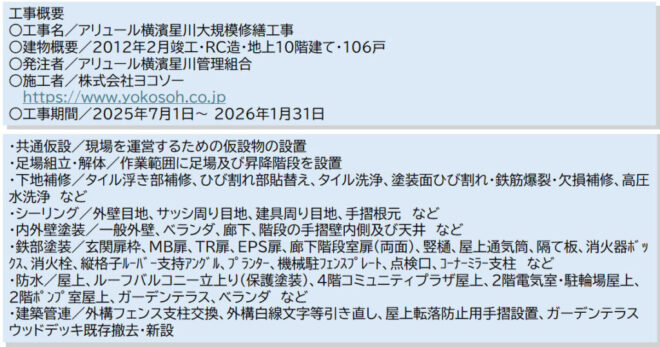
At Allure Yokohama Hoshikawa, completed in 2012, the trigger for undertaking the first major repair work was the proposal from the management company, similar to most other condominiums.
In 2022, when the building turned 10 years old, the management company conducted a building inspection in accordance with the long-term repair plan and submitted an estimate for the major repairs. The amount was approximately 280 million yen, or about 2.8 million yen per unit. Seeing such a large figure, the board at the time decided, "We cannot just leave it to the management company" and "We need a committee with continuity," and established a repair committee as a suborganization under the board, which rotates annually.
The committee recruited members from the residents, and five people became members. However, since they were not experts, they didn’t know how to proceed with the construction. The repair committee gathered information from books, the internet, and exchanges with other condominium associations, and learned that the standard approach is not the management-company-responsible execution method, but the design supervision method. Thus, they decided to commission a design consultant for the work.
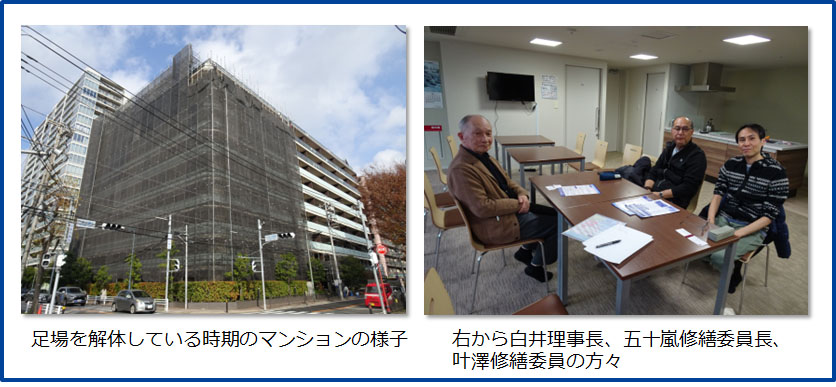
Construction companies were invited to apply publicly, with 11 companies entering. After document screening, 4 companies were selected for interviews, and finally, Yokoso Co., Ltd. was chosen.
The main reason for selection was that the impression of the site manager's responses during the interview was good.
Additionally, there was a proposal to modify the metal fittings (supports) that secure the vertical louvers to the building structure to make future work easier, which also raised the committee’s evaluation. During construction, the site manager also proposed improvements, such as preparing drainage channels for future equipment upgrades.
Moreover, respondent handling was thorough, and the impression after completion was that Yokoso "looked in the same direction as the board and repair committee."
As for the construction cost, the contract with Yokoso was approximately 180 million yen, and after actual expense settlement, it totaled about 160 million yen. This represented a reduction of about 120 million yen from the management company’s estimate, approximately 1.2 million yen per unit. If they had left it to the management company at the initial estimate, it would have resulted in a significant loss.
The members of the repair committee felt a sense of satisfaction as they welcomed the completion and handover.



Water leakage from common areas: 'Condominium association liable for compensation' Falls under the 'occupant' of a structure according to Article 717 of the Civil Code

Damages Claim Case / Supreme Court, January 22, 2026
【Overview of the Incident】
In two lawsuits disputing whether a condominium unit owner who suffered damage to their unit due to water leakage from common areas could claim compensation against the management association, the Supreme Court recognized that "the management association is considered the possessor of the land and structures." As a result, it has been confirmed that unit owners can seek compensation from the management association.
In the judgment of the second instance (High Court), the liability for compensation was denied on the grounds that "the management association is not a possessor." If claims could not be made against the management association, affected parties would have to sue all unit owners, making it practically impossible to exercise their rights. The Supreme Court placed importance on this point and recognized that it is the responsibility of the management association, allowing unit owners to claim damages from it.
On the other hand, for the management association, an increase in compensation claims poses a risk of depleting repair funds.
Recommended response: Especially in aging condominiums, proper maintenance before any water leakage occurs is essential. Each unit owner raising their awareness of management responsibilities is key to preventing future disputes and a decline in property value.
Case in Nerima Ward
The Supreme Court has taken up two cases. We will focus on the case in Nerima Ward. (Click the image to enlarge)


Touring examples of community center reconstruction 'on site' Yokohama City · Completed in 1971 · 39 buildings · 696 units
 On February 15, the Housing Regeneration Division of Yokohama City, under the operational commission of the Yokohama City Housing Supply Corporation, held a "Housing Complex Forum and On-Site Tour."
The site is a large housing complex in Isogo Ward, Yokohama City. The water tower, which lacked seismic resistance, and the management office located underneath it were demolished. Along with changes to the water supply system, a new community meeting hall was constructed.
This time, with the cooperation of the management association, we were able to hear about the process and difficulties involved in rebuilding the new community meeting hall, as well as other initiatives and activities of the management association and neighborhood association.
Condominium Overview
Completed in March 1971, RC structure, 5 stories, 39 buildings, 696 units
Developer / Japan Housing Corporation (currently Urban Renaissance Agency (UR Urban Renaissance))
Management Company / JS Nippon General Housing
Regarding the residential buildings, a seismic diagnosis was conducted, and seismic safety was ensured. However, the water tower (which also served as the management office) was found to have insufficient seismic resistance. Because the collapse of the water tower could potentially damage the residential buildings, the New Management Office Building Operations Preparation Committee was established in 2019.
In December of the same year, a design briefing session for the new community meeting hall was held through a proposal system. Thereafter, the New Management Office Building Operations Preparation Committee worked to consider the usage image, costs, design proposals, and management operations while organizing residents' requests and sharing issues through resident surveys and resident exchange events.
The new community meeting hall was completed and handed over in March 2021. Due to the surge in construction costs, the design was changed from RC structure to wooden construction. However, it received the "Wood Design Award 2022" in the Heartful Design category from the Japan Wood Design Association (Chairman Kengo Kuma).
The construction cost of the new community meeting hall (building, exterior, etc.) was approximately 230 million yen (excluding demolition costs), funded by repair reserve funds.
Under the slogan "Turning the seismic performance shortage and crisis into an opportunity," the chairman stated, "Resident-led initiatives plus expert support are the problem-solving capabilities of the complex." Currently, the "Community Hall Management Team," comprised of personnel from the board of directors, neighborhood association, welfare commissioners, and various clubs, is in charge of its operation.

The water tower before demolition and the old management office

The new assembly hall after reconstruction

The management office with the blinds down (closed on Sundays, the day of the tour)

The scene of a concert held in the free space (main hall)

The party room is equipped with an all-electric kitchen

The books in the library corner are donated by residents. With desks, chairs, and Wi-Fi installed, it can be used for studying and work.

A conference room that can be integrated with the large hall by opening the sliding door

Entrance halls at three locations. Equipped with AEDs and children's play equipment that can be used in the park.

 Written by a real estate consultant, this book positions the 'home' as an 'asset' and guides readers on how to build wealth based on their home. It explains what determines a home's 'asset value,' how to evaluate individual properties, and provides advice based on the analysis of past property data.
The author states that the value of a condominium consists of both 'use value' and 'asset value.' Use value refers to commuting convenience, shopping ease, and safe, secure buildings, while asset value refers to comfort and minimal depreciation. This is how the author defines a good condominium.
The book recommends buying a condominium 'as a residence' rather than for 'investment purposes,' while finding ways to maintain its value. In other words, it suggests a 'half-living, half-investing' approach—living in the property as an owner while planning to sell it in the future.
However, this method is best suited for those who want to increase their assets by moving due to changes in family structure or life stage, while many people still favor long-term residence even with a condominium.
In any case, the book emphasizes that owning a condominium with high asset value can have a significant impact in retirement.
"Illustrated: Fascinating Condominium Stories That Will Keep You Awake at Night"
Published: October 21, 2025
Author: Aruto Oki
Format: A5, 128 pages
Price: ¥1,089 (tax included)
Publisher: Nihon Bungeisha Co., Ltd.
ISBN: 978-4-537-22320-0
'The Three Ailments' Plaguing Condominiums: When 'Someone Else's Problem' Becomes 'Your Own'
 We can be surprisingly indifferent to things that don’t concern us. As long as the fire doesn’t fall on us, we simply watch a fire across the river and mutter, 'That’s terrible.' However, when it comes to 'aging,' one day we suddenly see its shadow in the mirror, in the steps at our feet, or even on the walls of the home we have lived in for years, and we become unsettled. 'Aging' and 'death' are at the top of the list of things we don’t want to think about. Yet, it is precisely in the place we have avoided looking that the essence we need to confront is hidden.
◇
In a condominium community, three forms of 'aging' are currently converging at once. They do not occur individually but intertwine with each other, creating a negative spiral.
■Aging of Buildings (Physical Deterioration)
Rust on pipes and peeling concrete. Visible aging can lead to an "economic ailment" in the form of insufficient repair reserves. However, it is said that if the management association acts with determination and properly formulates a long-term repair plan, the building itself can potentially last for 100 years. Among the 'three types of aging,' this is something that is relatively easy to address.
■Aging of the Population (Resident Aging)
As residents age, those who can serve as board members of the management association disappear.
If the association shifts to a management company-based system just because there are no volunteers for the board, decision-making is left to others, and management companies, construction companies, and inspection companies can freely use the association's funds as they please. Eventually, when the association's funds run out (lack of reserve funds for repairs), the property will simply be abandoned.
Unlike the 'aging of buildings,' it is the lack of initiative among the owners that becomes the problem, and in the end, the property is abandoned and falls into slum conditions.
This can be described as a typical example of a negative spiral.
■ Aging of Rules (Obsolescence)
Management regulations that do not comply with standard management agreements lag behind modern needs such as disaster and emergency response, and rationalization through IT.
Recently, there has been a major revision to the Condominium Act, prompting each condominium to review its management regulations.
If not now, then when?
Will someone else do it?
It is the "will" of the people living as condominium owners. Without it, it will simply deteriorate into slum-like conditions.
◇
Indifference such as "I am still young" or "This condominium is fine" is nothing more than a cessation of thought. And "social death," or social isolation, can suddenly appear before you one day.
To resist or coexist with this aging, it is essential to have "new tools" such as planned repairs, the introduction of third-party management systems by experts like condominium managers, and the utilization of digital technology.
Confronting the three types of aging in a condominium is an extremely proactive "life" issue, especially for older condominium owners, to ensure they do not face the greatest loss at the end of their lives.
Below, how is the "degree of aging" in your condominium?
□ Greetings among residents have decreased, and you do not know who lives next door (or if the unit is vacant)
□ The number of elderly living alone has increased, and concerns about safety checks and solitary deaths have become topics of management
□ Few people attend the general meeting, and it barely passes with proxies alone
There are signs of "social death" and slum-like conditions. Fundamental reforms involving experts are necessary.
<All Japan Building Center - Large-scale Repair Work Newspaper Editorial Committee 2026-3-02>
'Condominium AI' Usage Tips ⑦ Try consulting with 'Condominium AI'!
 Let's try consulting with 'Mansion AI'!
Currently, 'Mansion AI' from the Zenken Center receives numerous questions from condominium board members and association members, and there are actual cases where Mansion AI provides answers to them. In this section, we introduce real examples of how condominium associations have been using 'Mansion AI' over the past few months.
[Supervision] Zenken Center Chief Director, Shigeyuki Sato
Q
What should be noted regarding construction contracts with contractors, warranties, and after-sales maintenance?
 A
A
We have summarized the key points to keep in mind regarding construction contracts with contractors, warranties, and after-sales maintenance based on the information below.
1. Points to Note in Construction Contracts
(1) Documenting the Contract
Contracts should always be made in writing, and oral agreements or notes should be avoided. Documentation is the first step in establishing a proper relationship between the main contractor and subcontractor (according to web search results).
(2) Clarifying Contract Details
The contract should clearly state the scope of work, construction period, costs, payment terms, and how changes or additional work will be handled. It is also recommended to use standard forms such as order forms, acceptance forms, and change instruction forms.
(3) Confirming the Warranty System
If there is a construction completion warranty or performance guarantee, its details should be confirmed, and the warranty period and coverage should be clearly defined.
2. Points to Note Regarding Warranties
(1) Checking the Performance Warranty Period
Confirm that the construction company will repair any defects free of charge during the performance warranty period after completion. Generally, a 10-year defect liability is required.
(2) Receiving and Storing the Warranty Certificate
After the completion of the work, receive the warranty certificate and properly store it along with related documents such as construction record photos and lists of materials used.
(3) Checking the warranty details
Check in advance the scope and conditions under which the warranty applies, and also understand the cases that are not covered by the warranty.
3. Points to Note for After-Sales Maintenance
(1) Conducting Regular Inspections
It is important to carry out regular inspections in the first or second year after completion and to address any issues promptly if they arise.
(2) After-Sales Maintenance Agreement
Clearly state the details and duration of after-sales maintenance in the contract, and ensure that the construction company has a system in place to respond responsibly.
(3) Checking the Construction Company's Responsiveness
Investigate past cases and reputations to confirm how well the construction company handles after-sales maintenance. It is important to choose a reliable construction company.
4. Key Points for Preventing Problems
(1) Utilizing Third-Party Organizations
It is recommended to use construction supervisors or third-party organizations to check the progress and quality of the construction.
(2) Ensuring Communication
By holding regular meetings with the construction company and sharing the progress and any issues, potential problems can be prevented.
(3) Conditions for Contract Termination
In case the construction company fails to fulfill the contract, the conditions and procedures for contract termination should be clearly stated in the contract.
By keeping these points in mind, you can prevent issues in contracts with construction companies and after-service maintenance, allowing construction to proceed with peace of mind.
Are you troubled by frequent urination?

 Frequent urination and nocturia can cast a shadow over daily life, bringing a sense of urgency like, 'Not again, the bathroom…' It is said that about one in 2.5 women in their 60s experience urinary problems, so it is by no means an uncommon issue. People tend to suspect a bladder infection, but if frequent urges occur without significant pain or bleeding, an 'overactive bladder' may be the underlying cause.
There are four major signs of an overactive bladder. ① Frequent urination: going to the bathroom eight or more times during the day with small amounts each time. ② Nocturia: waking up three or more times at night to urinate. ③ Urgency: a sudden, intense urge to urinate that is difficult to control. ④ Urge incontinence: leaking before reaching the toilet. Among these, frequent urination and nocturia can be particularly insidious, gradually reducing quality of life as a 'silent stress.'
So why does it occur? An overactive bladder is a condition in which the bladder's ability to hold urine diminishes, causing it to contract and signal the need to urinate even with a small amount of urine. With aging, the bladder lining may atrophy, making the bladder itself smaller and stiffer. Repeated bladder infections or chronic inflammation of the lining can also make the bladder more sensitive. Furthermore, strong stress, cold, or prolonged tension can disrupt the autonomic nervous system, making bladder control ineffective and causing frequent urges. Issues with 'supporting and compression forces' also play a role, such as weakened pelvic floor muscles causing bladder prolapse, or the bladder being compressed due to organ prolapse or constipation.
The first step in maintaining health is to 'reduce factors that stimulate the bladder and create an environment where urine can be retained.' Swallow's nest extract is sometimes mentioned as a measure against age-related atrophy, but in daily life, the first thing to do is not to ignore dryness and cold in the body. Especially for those who suffer from frequent urination at night, coldness before bed can easily trigger it, so warming up thoroughly in a bath and taking measures to avoid catching a chill afterward is effective. Simple practices like placing a heat pack on your abdomen to 'warm and protect' your lower belly should not be underestimated.
Next, for people whose bladder mucosa is prone to irritation, it’s important to adopt a 'diet that does not promote inflammation.' Reducing wheat products (gluten) and sweets can be a key point for those likely to develop chronic inflammation. It is also recommended to be mindful of excessive intake of vegetable oils.
Often overlooked is the pelvic floor muscles, which provide 'support from below.' For those experiencing urinary leakage or a sense of sagging, regular pelvic floor muscle training (commonly known as Kegel exercises) can help reduce stimulation to the bladder. The key is not 'one strong effort,' but 'weak effort every day.' By embedding it into daily life like brushing your teeth, your body will respond to the changes.
Frequent urination and nighttime urination tend to worsen the more you try to endure them with willpower. Cold, inflammation, stress, muscle weakness, constipation, and sagging—don’t attribute it to a single cause. Adjust your lifestyle according to the factors that seem relevant to you. Reducing the number of trips to the toilet is also a way to regain freedom of movement. Don’t dismiss the discomfort as 'just due to aging'; start making small adjustments today.
(Rie Takada, Pharmacist, International Chinese Medicine Practitioner, International Medicinal Cuisine Specialist)
<Provided by Interesting Column>//omosiro-column.com/
 The 80th Anniversary Online Condominium Association Seminar will be held on Sunday, April 26.
Thanks to everyone's support, the "Condominium Association Seminar" has reached its 80th session. We will continue to plan and conduct timely seminars that align with current trends, so we appreciate your continued support.
In this seminar, we will provide details about the recently established "General Incorporated Association Condominium Management Research Institute (Abbreviated: Condominium Research Institute)," which is expected to help resolve bid-rigging issues. The seminar will also cover the following themes:
● Dissatisfaction with management companies (costs, slow response, lack of proposals, etc.)
● Risks of sudden contract termination notices
● Difficulty in changing management companies due to economic conditions
● Risks of the "Management Company Overseer System"
● The need for new ways to collaborate with management companies
● Exploring the answer to an ideal partnership in the seminar
For more details about this seminar and to register for participation, please click here (click the banner or URL to open the dedicated website).

下記の広告バナーをクリックすると、当該企業のHPが開きます。(順不同)