Large-Scale Renovation Work News – August 2026, Issue No. 200

Zenken Center / Free AI-based building diagnostic service offered to the first 20 management associations

Launched on January 5, 2010, *Large-Scale Repair Work News* (Daikibo Shuzen Koji Shimbun) reached its 200th issue with the August 2026 edition. The entire editorial team extends its deepest gratitude to our readers for their continued warm support and readership over the years.
At the time of the publication's launch, condominium buildings were aging, and the need for large-scale repair work was growing. However, management associations and residents often lacked sufficient knowledge regarding these repairs, making it difficult to formulate appropriate plans or select suitable contractors.
It was against this backdrop that *Large-Scale Repair Work News* was established as a specialized information outlet dedicated to providing insights on condominium management and repair projects, thereby supporting management associations in their decision-making processes.
To commemorate the 200th issue, Zenken Center is offering a free AI building diagnostic service to the first 20 management associations to apply. |
Representatives from condominium management associations and industry consultants gathered at this event to discuss past cases and various challenges.
For instance, one case study highlighted a situation where the selection of a design consultant and a construction contractor had to be cancelled due to insufficient explanation provided to the residents.
Our series "Chronicles of Management Association Repair Struggles"—which covers large-scale repair projects—has grown to include over 100 articles. By archiving these stories and enabling keyword searches for past cases and legal precedents, we provide an environment where management associations and residents can efficiently gather information.
In this way, *Large-Scale Repair Construction News* has supported the decision-making processes of management associations and residents—and contributed to the development of the industry as a whole—by providing vital information regarding large-scale condominium repairs.
At the time of our launch, there was a pressing need to address the information gap amidst the aging of condominium buildings and the growing necessity for repair work. Numerous instances of construction plans being revised due to inadequate communication with residents underscored the critical importance of information sharing.
We remain committed to meeting your expectations by delivering reliable information and fostering a platform for exchange. We look forward to your continued support.
Shoichi Yoshino, Representative Director, Zenken Center
Frequent falls from windows and balconies! Protect children's lives!

 On July 16, the Ministry of Land, Infrastructure, Transport and Tourism (MLIT) issued a notice to relevant organizations titled "Regarding Responses to Accidents Involving Children Falling from Residential Windows and Balconies (Re-notification)."
Prior to this, the Consumer Affairs Agency held the 164th meeting of the Consumer Safety Investigation Commission on May 27, where hearings regarding accidents involving children falling from homes were conducted. In response to the Commission's views on "Accidents Involving Children Falling from Residential Windows and Balconies" (with a report scheduled for release in June 2025), MLIT, the Ministry of Economy, Trade and Industry (METI), and the Children and Families Agency outlined the status of their initiatives and confirmed relevant points.
A total of 134 accidents involving children falling from residential windows and balconies have occurred over a 32-year period. Above all, to prevent such accidents, it is essential that thorough caution be exercised across all sectors and by all parties involved.
・"Video Reenacting Children's Falls from Windows and Balconies" (from the Consumer Affairs Agency website)
//www.caa.go.jp/policies/council/csic/report/report_025/movie_001/
・ Checklist for Preventing Falls Involving Children
//www.caa.go.jp/policies/council/csic/report/report_025/assets/csic_cms201_250624_40.pdf
・Guidelines on Housing and Residential Environments Designed with Child-rearing in Mind (Revised Edition))
//www.nilim.go.jp/lab/hbg/kosodate/guideline.html
Transcript of the 81st Online Seminar for Condominium Management Associations "Strategies for Condominium Management Associations to Overcome Bid-Rigging Issues" (Part 1)
 The following is an excerpt and summary of the 81st Online Seminar for Management Associations, launched on June 28 by the National Building Survey and Diagnosis Center. This report covers a lecture titled "Strategies for Condominium Management Associations to Overcome Bid-Rigging Issues," delivered by Ms. Kaori Segawa (an "Avatar Board Member" affiliated with the Center).
The theme of today's seminar is "Strategies for Condominium Management Associations to Overcome Bid-Rigging Issues."
1. The truth behind the unreported bid-rigging scandal
On March 4, 2025, the Japan Fair Trade Commission conducted on-site inspections of condominium repair contractors in the Kanto region on suspicion of violating the Antimonopoly Act. Media reports cited figures of 20—or perhaps as many as 30—companies involved, and suggested that consultants might also be implicated.
While media coverage has focused largely on the number of construction firms, there is an unreported reality: the number of companies subjected to inspections was not merely 20 or 30, but is said to exceed 60 in practice.
In other words, it is safe to assume that virtually every company a resident of a Kanto-area condominium might consider hiring for repair work was subject to these inspections.
Therefore, it is essential that you take this fact into account and act realistically.
Over the past year, as management associations select construction firms—a topic frequently raised in inquiries to our center—many have been scrambling to identify which companies *did not* undergo inspections. They tend to make a simplistic binary judgment: that companies subjected to inspections are "bad," while those that were not are "good."
As I mentioned earlier, more than 60 companies actually underwent inspections. Viewed realistically, this means that finding a company that was *not* inspected is extremely difficult.
Does the fact that a company did not engage in bid-rigging guarantee that it will deliver high-quality construction? I urge you to pause and consider that "no bid-rigging" does not automatically equate to "high quality."
This atmosphere of near-panic creates an opening for "imposter" board members or committee members—and the construction firms associated with them—to exploit the situation.
I want to emphasize the significant danger inherent in this state of affairs.
Cases of impersonation involving condominium repair work have even escalated into criminal matters. It is a grave issue. Many people are unaware of this, but in reality, this issue is far more serious, vexing, and critical than the problem of bid-rigging.
I want you to be aware that there are companies that employ sales tactics designed to exploit the anxiety management association members feel regarding bid-rigging; they capitalize on the resulting panic to their own advantage.
2.Guidelines for Management Associations to Prevent Bid Rigging There are no experts or organizations providing concrete methods on how a management association can actually prevent bid rigging. Nor is there any media coverage on this topic.
Instead, the media simply stokes the panic felt by management associations, as I mentioned earlier.
Therefore, considering this to be the most critical issue, I will explain the guiding principles and concrete methods for action.
How can a system be established to prevent bid rigging?
First, let us look at what *not* to do: excluding companies solely based on whether or not they were involved in bid rigging.
What happens if you restrict the pool of candidates based merely on past involvement in bid rigging? As I mentioned at the beginning—a fact that has gone unreported—the Japan Fair Trade Commission has investigated over 60 companies. This group includes many contractors with extensive experience and technical expertise capable of delivering high-quality work.
Consequently, there is a high risk of ending up with a contractor that lacks experience and technical skill and delivers poor quality.
Next, let us consider what *should* be done: the management association must firmly establish a system to prevent bid rigging.
The prerequisite for building such a system is deliberation based on accurate information.
What constitutes accurate information? Relying on online reviews or the opinions of strangers you have never met—people claiming a certain company is "bad"—does not qualify.
That is not accurate information.
At this stage, the most reliable information comes from the guidelines and notifications issued by the Ministry of Land, Infrastructure, Transport and Tourism (MLIT). The Ministry has already published various methods for preventing bid rigging.
Yet, the media only stokes alarm; they never report the fact that the Ministry has provided methods to prevent bid rigging. This is another fact that goes unreported.
Deliberation based on accurate information is the fundamental prerequisite.
This means utilizing the guidelines and notifications issued by the Ministry of Land, Infrastructure, Transport and Tourism, which outline various methods for preventing bid rigging. In light of this, it is vitally important—and indeed the proper course of action—for all of you to engage with the information, fully grasp the situation, and take appropriate action. I would like to emphasize this point. (To be continued in the next issue)
Launch of Condominium Management Consultant Audit System / Zenken Center
 At Zenken Center, we have established a system—the "Condominium Management Consultant Audit Method"—in which condominium management associations and their boards of directors take the lead, while certified condominium management consultants provide support across practical, legal, and technical areas. By putting in place a support structure that ensures the system functions effectively, we aim to achieve highly transparent operations and facilitate smooth consensus-building.
Zenken Center has maintained a consistent stance since its inception: the condominium unit owners themselves must always be the ones driving the management association's operations. This fundamental principle remains unchanged to this day.
I will now explain the background and circumstances that led Zenken Center—guided by this philosophy—to launch the "Condominium Management Consultant Audit Method" service. The ultimate goal of the Zenken Center’s "Condominium Management Consultant Audit System" is simply this: to ensure the board of directors functions effectively.
However, the biggest issue facing condominiums today is the shortage of residents willing to serve as board officers.
"If the management company takes on the role of administrator, the burden on officers is reduced."
"Management outsourcing fees become cheaper."
"You won't have to worry about major projects like large-scale repair work."
Management companies sometimes use such tempting arguments to encourage a shift to the "management company as administrator" model.
It is only natural to want to avoid a position that entails significant responsibility.
This sentiment is often reinforced by narratives emphasizing how difficult and burdensome the roles of board president and officers are. Furthermore, the Ministry of Land, Infrastructure, Transport and Tourism has issued guidelines and established various constraints, effectively giving its seal of approval to the "management company as administrator" model.
Of course, it is true that serving as a board officer for a management association is demanding. Many people fulfill these duties in their limited spare time while balancing their regular jobs.
The reality is that it is indeed difficult to handle these responsibilities casually on the side. Nevertheless, the fundamental principle remains: you must protect your own valuable assets—your condominium ownership rights.
However, under the "management company as administrator" model, the board of directors ceases to exist. Consequently, everything—from day-to-day operations to large-scale repairs—is driven by the management company acting as the administrator.
Moreover, once a transition to this model is made, reversing it becomes difficult; in some cases, returning to a board-led system proves impossible.
The Zenken Center’s stance is unwavering: the driving force behind the management association’s operations must always be the unit owners themselves.
Our "Condominium Management Consultant Audit System" is designed with a contract structure that allows you to revert to a board-led system whenever you wish. In short, it is a mechanism available for use only when needed.
Our staff—including highly experienced condominium management consultants—support the association's operations while ensuring the unit owners remain in the driver's seat. We work alongside the association rather than having them simply "outsource" everything to us.
So, what exactly is the role of the Zenken Center’s Condominium Management Consultant Audit System? Key responsibilities include supporting board operations and consensus-building; providing guidance on legal interpretations—such as the Act on Building Unit Ownership—and complex management bylaws; and overseeing projects ranging from large-scale renovations to routine maintenance and repairs.
A professional condominium management consultant charts the course, while the board of directors—representing the owners—makes the final decisions. We believe this collaborative approach defines the true role of a professional in condominium management.
We invite you to experience Zenken Center’s "Condominium Management Consultant Audit System." Consultations can be requested at any time via the inquiry form on our website.
For more details, please contact us here.
//zenken-center.com/mkk
Consultation by Phone
050-3852-3770
Consultation via Email
info@zenken-center.com
Reference Material: Zenken Bunko No. 65 — "What Is the 'Condominium Management Consultant Audit Method'? The Definitive Solution to Bid-Rigging Issues"
//z-center.net/zenkenbunko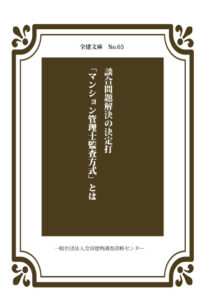

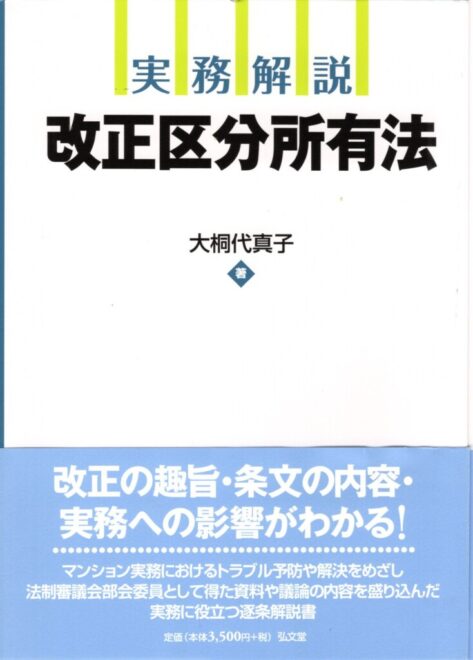
Practical Commentary: The Amended Act on Building Unit Ownership, etc.
Designed for intermediate-level readers and practitioners. The amended Act on Building Unit Ownership, etc. (often referred to as the "Condominium Ownership Act") came into force on April 1 of this year, marking the first major revision in approximately 23 years.
Key amendments include the introduction of resolutions based on a majority of attendees, the exclusion of owners whose whereabouts are unknown, and the relaxation of requirements for redevelopment and the sale of the entire building. These changes are intended to comprehensively address the "dual aging issues" facing condominiums: the physical aging of the buildings themselves and the aging—or disappearance—of the owners.
This book provides a detailed explanation organized into chapters covering topics such as facilitating condominium management and the Act on Proper Condominium Management (first half), and facilitating condominium revitalization (second half). It incorporates practical considerations (impact on actual operations), the background of the legal amendments, and relevant court precedents.
*Practical Commentary: The Amended Act on Building Unit Ownership, etc.*
Published: April 2, 2026
Author: Shimako Ogiri (Attorney, Dai-ichi Tokyo Bar Association)
Format: A5 size, softcover, 312 pages
List Price: 3,850 yen (tax included)
Publisher: Kobundo Co., Ltd.
ISBN 978-4-335-36054-1
(link)
//www.koubundou.co.jp/book/b10159365.html
Regarding refusal of entry to the unit where the water leak originated: Court grants permission for entry and orders payment of damages and indirect enforcement penalties.

Tokyo District Court, February 18, 2025
【party】
Plaintiff: Company X (located on the 1st floor) and its representative, X1 (operator of a day-service/outpatient nursing care facility)
Defendant: Y (unit owner of the 2nd floor)
1 Overview of the Case
This is a lawsuit in which the court ordered Unit Owner Y—who had stubbornly ignored water leakage from the floor above and persistently refused entry to their unit—to allow access to the room, pay 1 million yen in damages, and pay 50,000 yen per month until the repairs were completed.
【Sequence of events regarding the issue】
1. Severe Water Leakage
Around June 2023, water began leaking from the ceiling of the first-floor adult day-care facility. The company operating there continued its business while resorting to makeshift measures—such as affixing plastic sheeting to the ceiling and using hoses and buckets—to desperately divert the water.
2. Resident on the Floor Above Refuses Entry
To investigate the source of the leak, the management association repeatedly requested access to the unit owned by "Y" on the second floor, but Y adamantly refused. Consequently, the cause remained unknown, and neither insurance processing nor repair work could proceed.
3. Lawsuit Filed After Patience Ran Out
Frustrated and unwilling to tolerate further disruption to its operations, the first-floor company filed a lawsuit against Y. The company demanded that Y stop obstructing the management association's inspections and repairs and sought compensation for damages—including lost revenue (approximately 4.7 million yen plus a daily rate).
【Court's Decision】
The court largely upheld the claims made by Company X (located on the first floor) and issued the following orders against Y:
① Do not obstruct entry into the unit
Y must not, under any circumstances, obstruct the management association from entering the second-floor unit to investigate or perform repairs regarding the water leakage.
② Pay "1 million yen" in damages for losses incurred to date
Y is ordered to pay 1 million yen (plus interest) to Company X as compensation for liability arising from the failure to address the water leakage and the persistent refusal to allow an inspection.
③ Pay "50,000 yen per month" until the issue is resolved
Starting November 1, 2024, Y must pay 50,000 yen per month (as an indirect enforcement penalty) to X until the inspection and all repair work on the unit are completed. *Pursuant to Article 248 of the Code of Civil Procedure, and based on factors such as repair estimates, the court determined that damages amounting to 50,000 yen are being incurred monthly until the work is finished.
【Reasons for the court's decision】
1. Entry into the Privately Owned Unit
The Act on Building Unit Ownership, etc., and the management bylaws stipulate that there is a right to access another person's unit when necessary for repairs or to investigate the cause of an issue, and that entry must not be refused without a legitimate reason.
Given that a water leak was occurring directly beneath the second-floor unit, there was an extremely high probability that the source lay within that unit; consequently, Y’s continued refusal to allow entry without a valid reason was deemed entirely unlawful (an actionable tort).
2. Regarding Compensation for Damages
The company on the first floor claimed, "Our day-care service revenue dropped due to the water leak; therefore, we demand full compensation for the lost revenue (4.7 million yen)."
However, upon a detailed examination of past revenue data, the court found instances where revenue actually increased following the leak, leading to the conclusion that it could not be definitively stated that the water leak was the sole cause of the revenue decline.
Nevertheless, the fact that the business had to operate with buckets and hoses lined up under a water-soaked ceiling confirmed that the building had sustained significant damage. Taking into account that Y’s refusal to grant access prevented the acquisition of an accurate repair estimate, the court exercised its discretion to determine appropriate compensation amounts: 1 million yen for past damages and 50,000 yen per month for future damages until the construction work is completed.
【[Future Course of Action】
While the matter at hand concerns a dispute within a privately owned unit, the 2025 revision to the Standard Management Bylaws—aligned with the amended Act on Building Unit Ownership, etc., taking effect in 2026—stipulates under Article 23 (Entry into Necessary Areas, etc.) that, regarding the management of common areas, the management association may "demand to carry out preservation work itself." This implies the authority to enter the unit where the water leakage originated and to perform repairs on the leaking section on behalf of that unit's owner.
Given the existence of such judicial precedents, we recommend revising the management bylaws of your condominium in conjunction with the recent amendment to the Act on Building Unit Ownership, etc.
Consider shifting your approach to repair reserve funds from "defense" to "offense." What is the smartest choice for asset management?
 It has been announced that the interest rate for the "Mansion Smile-ru Sai" (Condominium Repair Reserve Fund Bond) issued by the Japan Housing Finance Agency—specifically for the 2026 fiscal year offering—will be 2.000% per annum (average annual rate at 10-year maturity, before tax).
This represents an increase of approximately fourfold compared to the previous fiscal year's rate of 0.525%.
In recent times, the cost of repair materials has skyrocketed, forcing condominium management associations to raise repair reserve fund contributions whenever they revise their long-term repair plans. However, amidst rising market interest rates, there is a growing trend toward exploring new ways to manage these reserve funds.
Here, we introduce the main financial products available for consideration by condominium management associations. Since these are association assets, the risk of a loss on the principal is out of the question.
The three main options are: the "Mansion Smile-ru Sai" issued by the Japan Housing Finance Agency; "New Over-the-Counter Government Bonds" (available for purchase by corporations); and "Japanese Government Bonds for Individuals Plus" (scheduled to become available to management associations starting with the December 2026 offering).
1. "Mansion Smile-ru Sai"
"Mansion Smile-ru Sai" is a 10-year interest-bearing bond issued by the Japan Housing Finance Agency (hereinafter "the Agency") specifically designed for the management of condominium repair reserve funds.
○ Preferential Loan Interest Rates / A major benefit is that if an association holding these bonds later utilizes the "Mansion Smile-ru Loan" for repair work on common areas, the loan interest rate is reduced by 0.2% per annum, and the guarantee fee is lowered by approximately 20%.
○ High Interest Rate (Bonus Rate) / While the standard type offers an interest rate of 2.000% (1.6938% after tax) based on the June 2026 example, a higher rate of **2.100%** (1.7784% after tax)—designated as the **"Certified Smile-ru Sai"**—applies if the condominium has received "Management Plan Certification." ○ Proven Safety: The issuing organization is wholly owned by the government and holds a credit rating equivalent to that of Japanese government bonds. Furthermore, the bonds are structured so that repayment takes priority over other obligations regarding the organization's assets.
○ Commission-free Early Redemption: Once one year has passed since the initial issuance, early redemption is possible without fees, in units of 500,000 yen.
2. "New Over-the-Counter Government Bonds"
"New Over-the-Counter Government Bonds" (New OTC-Sales Method Government Bonds) are fixed-interest government bonds that condominium management associations have long been able to purchase and manage without restriction.
○ Fixed Interest Rate System: Available with maturities of 2, 5, or 10 years, these are fixed-interest products where the rate set at issuance applies until maturity. Interest is paid twice a year (semiannually).
○ High Safety: Because the government takes responsibility for the payment of principal and interest, these bonds are characterized by extremely high safety.
○ Asset Protection: Even if the financial institution holding the account fails, the holder's rights remain protected; therefore, funds can be managed without concern for the 10-million-yen coverage limit of the deposit insurance system (payoff scheme).
3. "Government Bonds for Individuals Plus"
"Government Bonds for Individuals Plus" is the name that "Government Bonds for Individuals" will adopt as the eligibility for purchase—previously limited to individuals—is expanded. Under a decision by the Ministry of Finance, condominium management associations—regardless of whether they possess legal entity status—will be able to purchase these bonds starting with the subscription period in December 2026 (for issuance in January 2027).
○ Extremely High Safety: Issued by the government, which takes responsibility for principal and interest payments, these bonds offer extremely high safety. Even in the unlikely event that the financial institution holding the account fails, the right to receive principal and interest remains protected.
○ Early Redemption Without Principal Loss: Once one year has passed since issuance, the government will repurchase the bonds at a price close to the principal amount at any time. Unlike standard government bonds sold at market prices (such as "New Window-Sales Government Bonds"), a major source of peace of mind is that the principal remains intact even upon early redemption (though an adjustment equivalent to the interest from the two most recent payment periods is deducted).
○ Small-scale investment: Purchases can be made starting from a minimum of 10,000 yen (in 10,000-yen increments), allowing for flexible accumulation based on available funds.
4. Practical considerations
When managing funds for a management association, the most important priority is not "growing the capital," but rather "being able to withdraw the funds exactly when needed without losing a single yen of the principal."
Rather than putting all funds into a single product, the wisest practical approach is to diversify based on time horizons—using the long-term repair plan as a guide—such as placing funds needed within three years into time deposits, while allocating funds not required for a decade or more into products like "Sumai-ru Sai" (Housing Bonds) or "Government Bonds for Individuals Plus."
<全建センター・大規模修繕工事新聞論説委員会2026-8-02>
"Mansion AI®" Utilization Tips 13: Try Consulting "Mansion AI®"!
 Why not consult "Mansion AI®"?
Zanken Center’s "Mansion AI®" is currently being used by board members and association members of numerous condominium complexes to ask questions and receive answers.
In this section, we present real-world examples of how management associations have utilized "Mansion AI®" over the past few months.
[Supervised by] Shigeyuki Sato, Lead Director, Zanken Center
Q
A water leak originating from Unit 301 affected the unit below; an investigation conducted under Unit 301's insurance policy revealed that the cause was rust on the bathtub's base structure. Can the cost of replacing and repairing the base be billed to the management association? The management bylaws do not list the bathtub base as part of the common areas.
 A
A
To state the conclusion first, regarding the cost of replacing or repairing the "bathtub base," it is highly likely—from a legal perspective (based on standard management bylaws and the Civil Code)—that claiming this cost from the management association would be extremely difficult; as a general rule, the expense would be borne by the individual owner.
Three reasons why making a claim is difficult
1. The bathtub base is generally considered part of the "exclusive-use area"
Although the scope of "common areas" is not explicitly detailed in the management bylaws, standard condominium laws and bylaws distinguish between "exclusive-use areas" (individual property) and "common areas" (shared property) as follows:
・Common areas: The building's structural framework (such as the concrete floor slabs) and shared vertical piping (risers).
・Exclusive-use areas: Interior finishes and fixtures within the unit, as well as branch pipes (horizontal piping) and equipment installed specifically for that unit.
The bathtub and its base (support frame) are integral parts of the "unit bath" fixture used exclusively by the resident of Unit 301.
Therefore, even if not explicitly stated in the bylaws, they are typically treated as part of the exclusive-use area.
2. The cause is "aging-related deterioration (rust) of the fixture"
The investigation into the water leak identified "rust on the bathtub base" as the cause.
If the rust was caused by a defect in a "common area" (such as the floor slab or shared piping) that the management association is responsible for maintaining, you could claim compensation or repair costs from the association.
However, if the rust resulted from the base's own aging, condensation, or daily use, the responsibility for its maintenance lies with the owner of Unit 301.
3. Nature of insurance (distinction between investigation costs and repair costs)
You mentioned that the insurance for Unit 301 (such as personal liability insurance or building insurance) covered the water leak investigation costs; however, there are general rules regarding the scope of insurance coverage.
・Investigation costs and compensation for damage to the unit below: Insurance often covers these.
・Repair costs for the source of the leak itself: If deterioration is the cause, the repair may be excluded from coverage (subject to an exemption), or—unless a special rider applies—the cost of repairing one's own property must be borne by the owner. Similarly, there is no legal basis for having the management association cover the repair costs for your personal property.
4. Next Steps and Points to Verify
① Check the "Scope of Exclusive-Use Areas" in the management bylaws.
Even if the unit bath is not listed under "Common Areas," check the "Exclusive-Use Areas" section for terms such as "complete unit bath assembly" or "equipment belonging to the exclusive-use area." If the unit bath is included there, the underlying base structure is definitely part of the exclusive-use area.
② Check for impact on the slab (concrete floor) or common piping.
Review the investigation report again to see if there are any unusual circumstances—such as moisture or water rising from beneath the floor (a common area)—rather than the rust being caused by a leak from above (the bathtub side). If the cause is entirely due to condensation or water leakage within the exclusive-use area, you cannot file a claim against the management association.
【summary】
Since the replacement of the base structure in this instance is highly likely to be classified as a "repair to equipment within a private residence" (similar to air conditioners or water heaters), the general rule is that the unit owner of Room 301 bears the cost.
Wisdom for the Information Age: Lessons from the Folktale "The Leak in the Old House"
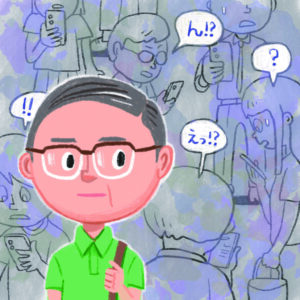

The folktale "The Old House's Leak" (Furuya no Mori) offers a lighthearted depiction of how a nameless fear can throw people into a frenzy. In a dilapidated house with a leaky roof, an old woman mutters, "The scariest thing in the world is the old house's leak." Thieves and wild beasts overhear this and, mistaking "the leak" for some mysterious monster, become terrified and flee on their own accord. What truly frightened them was not the monster itself, but the product of an imagination fueled by a name that had taken on a life of its own.
This dynamic holds strikingly true in today's society. On social media, for instance, brief phrases or snippets of video are often labeled with dramatic terms like "dangerous," "viral outrage," or "the beginning of the end" before their true nature is even clear. People react, share, and brace themselves before verifying the facts. Anxiety, having ballooned beyond the reality of the situation, takes on a momentum of its own, sweeping away reputations, the prevailing mood, and even sound judgment.
To view this as a modern fable, we are like villagers constantly hounded by the sound of notification alerts. A small vibration in our pocket makes us restless, convinced that something momentous has occurred. Yet, upon checking, we often find the message was nothing urgent at all. Despite this, we grant that "unseen something" power far beyond its actual substance. This is because anxiety that has been given a name moves people more easily than anxiety that remains nameless.
That is precisely why the humor in "The Old House's Leak" is more than just a quaint folktale trope. When gripped by fear, we need the wisdom to pause and re-examine the situation: "Is this truly a monster, or is it just a leak in the roof?" Perhaps half of what causes such a stir in the world is, in reality, nothing more than the sound of droplets falling from a roof. We cannot eliminate fear entirely. However, we can choose not to nurture it by slapping arbitrary labels on it. That restraint is a modest yet vital form of wisdom for navigating an age overflowing with information.
(Journalist Katsuhiko Inoue / Illustration: Tatsuchika Yoshida)
<Courtesy of the entertaining column>
Midsummer Greetings / Business Card Advertisements (in no particular order)
※Clicking on each advertisement screen will open the respective company's website.



What you will learn in this seminar

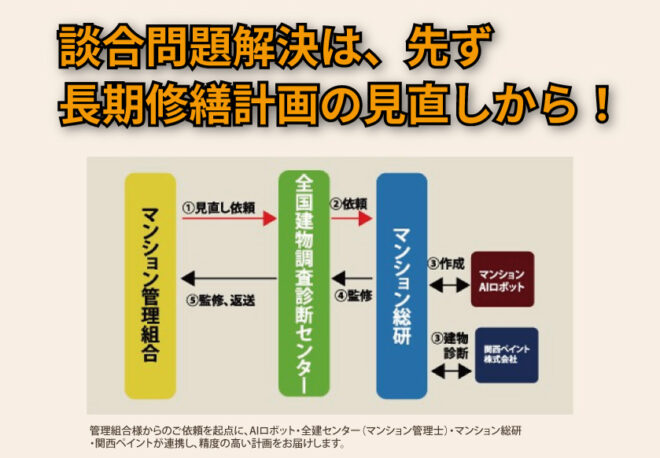
In this 82nd online seminar, the National Building Survey and Diagnosis Center will provide a detailed explanation of a new service it has recently launched. We are proud to introduce this groundbreaking system, which utilizes trending AI robots and incorporates supervision by condominium management consultants; by revising long-term repair plans based on a new type of building diagnostic report, it also resolves issues related to bid-rigging. We encourage you to learn about this service and give it a try at your earliest opportunity.
Zenken Bunko surpasses 65 titles; free digital versions are now available.


For over 17 years since its inception, the National Building Survey and Diagnosis Center (Zenken Center) has fostered connections with condominium management associations by regularly distributing the "Large-Scale Repair Work Newsletter." We have also held our management association seminars 80 times on a bimonthly basis. Furthermore, we have compiled the "experiential knowledge" accumulated through these activities into the "Zenken Bunko" series—now totaling 62 volumes—which are available for purchase. Moving forward, we will continue to gather, edit, and disseminate information derived from sources such as our seminars, newsletter interviews, and the various consultations handled by the Center. To mark the milestone of surpassing 65 volumes in the Zenken Bunko series, the Center has made the e-book versions available to management associations and condominium residents free of charge. A list of the free e-books is available on the dedicated website below; clicking on the image of a desired title prompts a request for a passcode, which can be found on the same site to access the e-book.
//z-center.net/zenkenbunko
Mr. Yoshino, Representative Director of the Zenken Center, explained the motivation behind this initiative: "As these materials are highly valued by many management association officers as a precious source of information, and in keeping with the founding principles of our organization, we hope that making them widely available for free will help resolve various issues facing the large-scale repair industry." He also expressed his determination to continue publishing the series, stating, "We aim to reach the goal of publishing 100 volumes."
The Zenken Bunko series can be viewed or purchased (as print editions) via the sites below:
1. By registering for the Zenken Library, you can view the entire Zenken Bunko series as e-books.
//zenken-center.com/library
Zenken Library Subscription Registration
//credit.j-payment.co.jp/link/creditcard/input
2.全建出版販売
//zenkenlibrary.shop-pro.jp
3.Amazon
4.TEBRA書店

Clicking the advertising banners below will open the respective company's website. (In no particular order)