Major Repair Work Newspaper September 2026, Issue No. 201
Kagawa General Law Office Symposium Held

Kagawa General Law Office held an emergency symposium on August 7 at the Bar Association Hall, focusing on two Supreme Court rulings issued on January 22, 2026.
◇
The January 22 Supreme Court rulings caused a big stir in the practical management of condominiums and the interpretation of the law. At this symposium, a heated panel discussion took place, examining the essence of condominium ownership law. In this article, we summarize what legal experts pointed out as the 'fundamental contradictions in condominium law.'
| Speakers: Eiki Maruyama (Professor Emeritus at Chiba University, Lawyer), Masaharu Ebisu (Lawyer), Hirofumi Hanabusa (Professor at Soka University), Azusa Fujimaki (Professor at Kokushikan University) Moderator: Kiri Kagawa (Kagawa General Law Office, Lawyer) |
The dilemma of the 'Two Apartment Law'
Why does such a gap occur? As a fundamental cause, Emeritus Professor Eiki Maruyama raised the concept of 'two condominium laws.' In 1982, the Ministry of Construction (now the Ministry of Land, Infrastructure, Transport and Tourism) led the creation of the 'Standard Management Regulations,' and the following year, in 1983, the Ministry of Justice led the revision of the 'Condominium Act,' but there was no contact between the legislators of the two. As a result, two different sets of rules with different philosophies coexist: the Condominium Act as property law and the standard management regulations and the Condominium Management Properness Act centered on management associations. He points out that the gap between practice (management association system) and law (co-ownership principles of unit owners) has deepened to the point where even courts suddenly use the term 'management association,' which has no legal entity, in their judgments.
Comparison with German Law and Future Prospects: How do other countries handle this? According to Professor Azusa Fujimaki, in Germany, following rulings in the 2000s, management organizations are now recognized as having 'full legal capacity,' allowing the organizations to exercise rights and perform obligations collectively. As a solution to break through Japan's current situation, lawyer Ebisu suggests, 'Stop operating as associations with ambiguous or no legal capacity and turn all condominiums into 'management association corporations.'' On the other hand, Professor Maruyama argued for the need for fundamental legal reforms, saying, 'Separate from the Condominium Act as property law, a new 'Condominium Law' should be legislated to set rules centered on management associations.'
Organizing the theory is urgent
Kagawa Nozomi, the lawyer who hosted the event, summed it up by saying, 'Before talking about ideals, it's essential to first clarify how far current laws can be interpreted and organize the theory.' In modern condominiums facing the 'two types of aging'—an aging population and deteriorating buildings—it's safe to say that correcting the gaps between legal theory and reality is an urgent task.
Launch of the 'Mansion AI® Consultant System Z'


At Zenken Center, we’ve just launched a new service called the 'Mansion AI® Consultant System Z,' where our certified condominium managers use the latest AI to handle building inspections, construction planning, and selecting the best construction companies for large-scale condominium repairs.
The features of System Z are as follows:
1. Long-term repair plan review system
The latest AI analyzes the building’s deterioration, construction history, and market trends to optimize repair plans so they’re just right—not too little, not too much.
2. Identifying construction companies using the T.M method
Based on building inspections and construction planning, the AI introduces the most suitable construction companies for the property in a unique way.
3. Supervision by certified condominium managers
Our condominium managers at Zenken Center supervise the entire process.
This is an innovative new system from Zenken Center that ensures fair and optimal construction with no room for collusion.
Record of the 81st Online Condominium Management Association Seminar: 'How Condominium Management Associations Can Overcome Collusion Issues' Part 2
 Following the previous issue, here’s an excerpt from the 81st Online Management Association Seminar, which the National Building Inspection and Diagnosis Center started streaming on June 28. This time, we’ll focus on "3. Concrete Methods to Prevent Collusion." The lecture is given by Kaori Segawa, an avatar director affiliated with the National Building Inspection and Diagnosis Center.
3.Concrete methods to prevent collusion① Request design consultants to submit materials with detailed
① Request design consultants to submit materials with detailed specifications and quantity sheets. How can we prevent kickbacks or back margins, and how do such things even happen? The first concrete method to prevent bid-rigging is to ask design consultants to submit materials that include detailed specifications and quantity sheets. Already, in the notice from the Ministry of Land, Infrastructure, Transport and Tourism’s Housing Bureau and Land and Construction Industry Bureau dated January 27, 2017, titled "Regarding the Notification of Consultation Desk for Ordering Major Condominium Repairs Using Design Consultants," it mentions the distance that should be maintained between inappropriate consultants and construction companies, explains how to handle this with management associations, gives concrete examples of how a specific construction company could be selected, and shows mechanisms to make kickbacks transparent, providing guidance on countermeasures. Regarding the notification on spreading awareness of the consultation desk for ordering major condominium repairs using design consultants.
//www.mlit.go.jp/common/001230147.pdf
I’ll repeat it, but the media doesn’t cover any of these issues at all.
A specific case is that a design firm, among five construction company candidates, only gave one company a smaller amount of work so that its estimate would come out lower, and that company ended up being chosen as the contractor.
Instructor: Kaori Segawa, affiliated with the National Building Inspection and Diagnosis Center / Avatar Director
So what this means is that the management association didn’t know that the quantities in the estimate details within the design documents were tampered with to favor a particular company.
For example, the area of the exterior walls or the waterproofing area might be written as a certain number of square meters, but they gave only the favored company a smaller area and instructed them to make estimates based on that.
This is something the general media doesn’t report on. What reports it is us, the National Building Inspection and Diagnosis Center.
Next, regarding the scheme to pay back margins, the notification from the Ministry of Land, Infrastructure, Transport and Tourism actually includes inappropriate measures.
These include unnecessary work or excessive design specs so that the construction costs can be inflated. Excessive design specs mean including items in the design deliberately to make the costs higher.
Also, they gave only one company a reduced quantity so that the cost of construction would appear lower.
To prevent this, by requesting the submission of detailed specification documents with quantity breakdowns created by the design consultant, you can disrupt such schemes.
However, if the management association can’t determine whether the detailed specs are excessive or whether the quantity breakdowns are correct, please ask us, the National Building Inspection and Diagnosis Center, as a second opinion.
We will carefully analyze the submitted documents to check whether the specifications are inflated and whether there’s any fraud in the quantity breakdowns.
②Request to view the report
The second specific method to prevent collusion is to ask the design consultant to 'allow the inspection of the report under Article 23-6 of the Architect Act.'
According to Appendix 1 <Examples pointed out> of the Ministry of Land, Infrastructure, Transport and Tourism (MLIT) notice, there was a case where a business was commissioned to the design consultant company that presented the lowest estimate, but it was discovered that the surveys, diagnostics, and designs were actually carried out not by the consultant's staff, but by the employees of the construction company.
In other words, the consultant was actually supporting the selection of the construction company using the construction company’s employees. As a result, the construction company was provisionally selected, but since the issue was discovered before the contract, the contract was not executed.
The 'report under Article 23-6 of the Architect Act' is a document that the operator of an architectural office is obliged to submit to the prefectural governor once every fiscal year. At the same time, it is stipulated that the submitted document must be made available for inspection upon request at any time.
The report needs to include a list of the architects belonging to the office, including their names, registration numbers, etc. By checking this regulation, you can clearly see whether someone is truly an architect affiliated with that architectural office.
We believe that using such legal documents as a measure against backdoor commissions is the most legitimate, fair, and effective procedure. This also helps eliminate impersonation.
Next, according to Appendix 2 <Cases of Initiatives> of the MLIT notice, there is an example where a design company that made a conflict-of-interest proposal was excluded from selection.
Relying on information from newspapers, magazines, and personal experience, they requested estimates from 15 companies, received estimates from 7 companies, carefully examined the cost, contents, track record, etc., and the management association selected construction companies that proposed cost-reducing measures such as narrowing down the construction items to the top 2 companies.
The big point here is that the management association obtained estimates without relying on a design consultant.
By having the management association itself carry out the act of getting estimates, a fundamental system is created that prevents design consultants from receiving backdoor commissions.
Nowadays, if there’s the motivation, there are actually many ways to support management associations in taking the initiative to get estimates themselves.
With digitalization advancing, there are sites and apps that make it easy for management associations to use even if they don’t know any construction companies, and these tools support obtaining construction estimates. We’d like to share this fact with everyone as well.
Attached is a list of sites and applications that support management associations in taking estimates themselves without relying on management companies or design consultants when they want to take the lead.
(App list: left table)
There are also many ways for a management association to take initiative and overcome the bid-rigging problem.
- In contracts with construction companies and design consultants, you can do things like 〇〇〇.
- For management associations facing their second or later major repair projects, doing 〇〇〇 creates an environment that can prevent bid-rigging and kickbacks.
In any case, going into more detail would get into information we refrain from disclosing in a seminar.
Since this information is quite specific, for those who want to know more, we would like to provide practical support as part of advisory contracts with the Japan Building Inspection and Diagnosis Center.
It's possible to create a system that prevents bid-rigging.
We hope you make good use of our support in addressing these issues.
Thank you very much for listening.
Long-life Model Project / Ministry of Land, Infrastructure, Transport and Tourism
 On June 22, the Ministry of Land, Infrastructure, Transport and Tourism announced the evaluation results for the first proposal call (held from April 1 to 15) for the FY2026 Condominium Stock Longevity Model Project. This time, there were 4 proposals from 4 parties, and one of them was evaluated as appropriate for adoption under the 'Pioneering Regeneration Model Type (Planning Support)' of the Condominium Stock Longevity Model Project.
 The project that was approved this time is a 56-year-old, 45-unit leasehold apartment building. Due to the frequent water leak incidents and the need for seismic reinforcement, a decision was made to promote rebuilding. It’s noted that they are building a business scheme with an eye on acquiring adjacent land based on the revised Condominium Act, and this has been praised for its uniqueness, creativity, and rational approach.

The upcoming application period for FY 2026 is as follows:
- 3rd round: September 14 (Mon) to September 18 (Fri), 2026
(Link)
//www.mlit.go.jp/jutakukentiku/house/jutakukentiku_house_fr5_000037.html

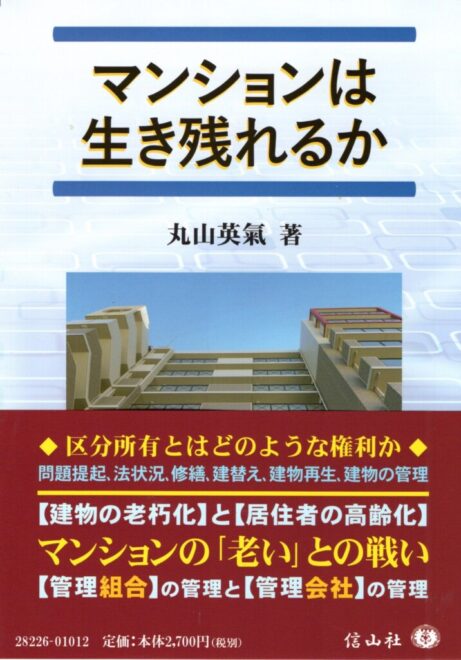
Can Condominiums Survive?
"Is it time to rethink the legal framework for condominium management?" Driven by factors such as the aging of unit owners and a general lack of interest, an increasing number of condominiums are appointing professional management companies to serve as the "administrator" defined under the Act on Building Unit Ownership.
However, a management structure relying solely on an administrator and general meetings creates conflicts with the management models outlined in the Standard Bylaws and the Act on Advancement of Proper Condominium Management. This book raises the issue and proposes the need for a new legal framework for management.
The author, who was instrumental in founding the Japan Condominium Society, examines the realities and challenges of condominium management—focusing on legal systems and other aspects—to address the various issues facing the current condominium system.
*Can Condominiums Survive?*
Published: July 30, 2026
Author: Hideki Maruyama (Professor Emeritus, Chiba University; Attorney)
Format: A5, softcover, 212 pages
List Price: 2,970 yen (tax included)
Publisher: Shinzansha Publishing Co., Ltd.
ISBN: 978-4-7972-8226-9
(Link)
//x.gd/l5EmN
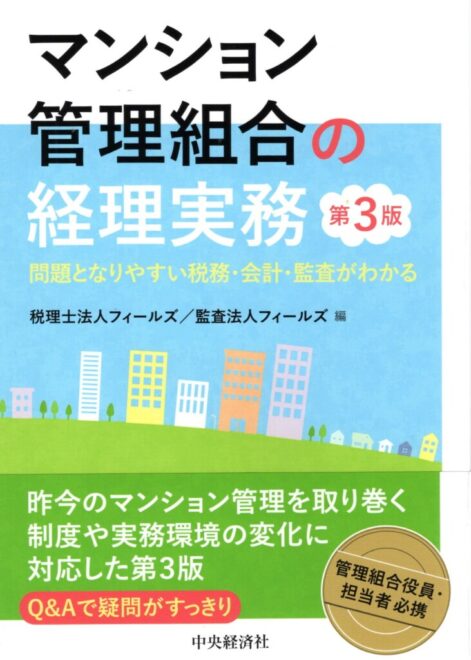
Practical Accounting for Condominium Management Associations (3rd Edition)
This book concisely compiles the expertise and know-how of Fields, an accounting firm specializing in services for condominium management associations and management companies.
Key revisions in this third edition include updated commentary and Q&A sections addressing recent changes in regulations and the operating environment, specifically: (1) compliance with the Qualified Invoice System; (2) monetization of vacant parking spaces; and (3) the growing adoption of the "external administrator" management model.
According to the National Tax Agency’s Q&A guidelines updated in December 2025, a clear distinction is now made between unit owners and occupants when determining whether the leasing of parking spaces constitutes a "profit-making business." Since occupants are not classified as unit owners, such leasing arrangements are now deemed to fall under the category of profit-making business if they are recognized as independent business activities.
*Practical Accounting for Condominium Management Associations*
Published: July 30, 2026
Editors: Fields Tax Corporation / Fields Audit Corporation
Format: A5 size, softcover, 240 pages
List Price: 3,190 yen (tax included)
Publisher: Shinzansha Publishing Co., Ltd.
ISBN: 978-4-7972-8226-9
Does a modification to the "balcony railing" constitute a "special impact"?

Tokyo District Court, February 18, 2025
【party】
Plaintiff: Unit Owner X
Defendants: Y1 (Management Association), Y2 (Management Company)
1 Overview of the Case
The apartment complex serving as the setting for this case was over 30 years old, and the balcony railings were suffering from rust and corrosion. As part of a major renovation project, the management association (Defendant Y1) planned to replace the existing "fence-style" railings with "aluminum panel-type" ones, which offered superior privacy and security.
An owner of a unit on the eighth floor (Plaintiff X) vehemently opposed this plan. X argued that the paneling would give the balcony a "pillbox-like" appearance—referring to a rugged, enclosed design reminiscent of the Russian military term for a sturdy concrete defensive fortification—and would impair sunlight, ventilation, and the view. Following the renovation, X filed a lawsuit against the management association seeking "restoration to the original state," demanding that only X's balcony be returned to the original fence-style railing.
【Arguments of the defendant management association】
In court, the management association argued for the legitimacy of the construction work:
1. Democratic process: Approval was obtained via a special majority vote at the general meeting, and the use of the "panel type" was clearly stated in the materials provided beforehand.
2. Multifaceted benefits: There were rational reasons for choosing the panel type, such as providing a privacy screen against the increasing number of surrounding high-rise buildings, preventing window breakage caused by flying debris during typhoons, and preventing objects from falling.
3. Resident preferences: A survey of all households revealed that a majority (28 out of 48 units) favored the panel type.
The central issue in the lawsuit was whether the modification of the handrails constituted a case of "exerting a special impact" as defined under the Act on Unit Ownership of Buildings. If such a "special impact" were recognized, the consent of the unit owners who would suffer a disadvantage would be required.
Although the court acknowledged that the installation of panels had indeed worsened sunlight exposure and the view compared to before, it dismissed Plaintiff X's claim for the following reasons:
・The height of the handrails themselves remained unchanged.
・There was insufficient concrete and objective evidence regarding the extent of the disadvantage (such as the specific reduction in hours of sunlight).
【Summary】
X was absent from the general meeting out of deference to the notice’s request to refrain from attending as much as possible—given that the extraordinary meeting was being held while the COVID-19 pandemic was ongoing—and consequently overlooked the "panel type" specification listed in the quotation.
Large-scale renovation projects go beyond mere repairs; they hold the potential to dramatically transform the living environment. While this specific case was influenced by the COVID-19 pandemic, a legal dispute might have been avoided had there been proper communication.
It is evident that the management association is once again called upon to provide "thorough explanations," while individual unit owners are expected to fulfill their responsibilities by "actively participating as stakeholders."
A Carefree Travel Diary in Photos (Part 3)
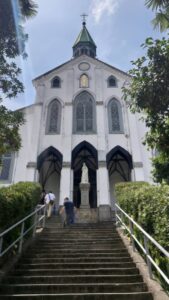
大浦天主堂

Diamond Princess

Diamond Princess Cruise: July 28 – August 5 (Part 1)
It is July 29, and I am currently aboard the *Diamond Princess*, which departed from Yokohama, sailing off the coast of Kagoshima Prefecture. Tomorrow, we will call at Nagasaki. The day after, we head to Busan, South Korea; following that, we will visit the Nebuta Festival in Aomori and the Port Festival in Hakodate before returning to Yokohama’s Osanbashi Pier on the 5th.
Since this cruise coincides with the school summer holidays, there were many families on board. The ship was fully booked with approximately 3,000 passengers—about 2,300 Japanese and 700 foreign nationals. Americans made up the largest group among the foreigners, numbering around 340.
The *Diamond Princess* was completed in 2004 at the Mitsubishi Heavy Industries Nagasaki Shipyard. It measures 290 meters in length and 37.5 meters in width. With a gross tonnage of 115,874 tons, the ship spans 18 decks and features 1,337 passenger cabins.
◇
On the 30th—our third day—we entered our first port of call, Nagasaki Port, at 10:00 AM.
I disembarked at 11:00 AM and headed to the boarding point for Gunkanjima (Battleship Island), but found no one there. I visited the Gunkanjima Digital Museum and purchased a ticket for the 1:40 PM departure for 6,000 yen (there are two sailings per day). With the time remaining before departure, I toured nearby sites, including Oura Church and the Former Mitsubishi Dock House, Former Ringer House, and Glover House within Glover Garden. Afterward, I enjoyed some Nagasaki *champon* noodles before heading back to the Gunkanjima boarding point.
About 40 minutes after setting sail, we arrived at Gunkanjima, where we moved between three designated observation areas and listened to guided explanations.
Gunkanjima is a maritime city created in the late 19th century by artificially expanding a natural island to efficiently mine the coal deposits lying beneath the seabed.
The Hashima Coal Mine was established on the island, and Mitsubishi began full-scale mining operations there in 1890. Facilities such as high-rise housing, schools, and a hospital were built on the island for the coal miners and their families; notably, Japan's first reinforced-concrete high-rise apartment building (Building No. 30, seven stories tall) was constructed in 1916, and by 1960, the island's population density exceeded that of Tokyo.
As the primary energy source shifted from coal to oil, the mine was closed in 1974, leaving the island uninhabited and in ruins. In 2015, it was inscribed as a World Cultural Heritage site under the name "Sites of Japan’s Meiji Industrial Revolution."
We returned shortly after 4:00 PM, and at 5:00 PM, we enjoyed a delicious meal at the Italian restaurant Sabatini, accompanied by beer and red wine.
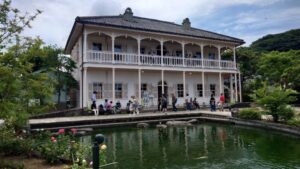
Former Mitsubishi Dock House at Glover Garden
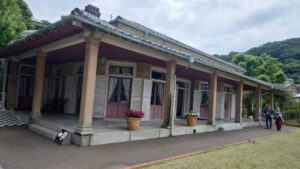
Former Ringer House
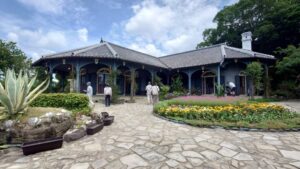
Glover House
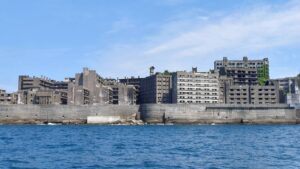
Gunkanjima 1
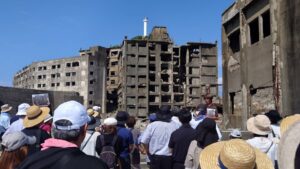
Gunkanjima 2
A Double Whammy: Material Shortages and Bid-Rigging Scandals What Now? Stalled Large-Scale Renovation Projects
 As of 2026, large-scale renovation projects for condominiums across Japan are facing severe stagnation due to the "Naphtha Shock," a crisis triggered by the situation in the Middle East.
A survey conducted by an industry association (carried out from April 3 to 10, with 87 of its 172 member companies responding) revealed that renovation schedules have been delayed for 594 condominium properties managed by 51 companies nationwide (including projects yet to commence).
Specifically, 42 companies (48.3%) reported facing difficulties in procurement or delivery delays affecting 356 properties.
The primary factors causing this stagnation and the current situation are outlined below:
1. Physical suspension of supply and shipment restrictions for materials
The situation is not simply a matter of paying a premium to secure supplies; actual physical supply stoppages are occurring. Major manufacturers are successively suspending orders or restricting shipments for products such as waterproofing materials, sealants, and solvent-based paints (including thinners). Consequently, there has been a sharp rise in cases where projects cannot begin due to the inability to procure materials, or where project schedules have to be completely scrapped and redrafted.
2. Shortage of renovation reserve funds due to rapid price surges

Even when supply routes for materials are successfully secured, prices have risen sharply.
This causes costs to exceed the budget originally set by the management association, necessitating discussions on revising plans or levying additional one-time assessments, which ultimately leads to a halt in construction work.
3. Requests from contractors to postpone or cancel, and shortened quote validity periods
There is an increasing number of cases where, just before construction is due to start, contractors request a postponement, citing an inability to procure necessary materials.
Furthermore, due to extreme volatility in material prices, the validity periods for price quotes tend to be set much shorter than in the past; the inability of management associations to reach a consensus—such as through a general meeting resolution—within these tight timeframes further exacerbates project stagnation.
4. The Issue of Bid Rigging
While the shortage of naphtha-derived materials represents an "external, physical factor," bid rigging by certain design consultants and construction companies acts as a "structural, human-induced factor" that further exacerbates the stagnation of large-scale repair projects from within.
5. "Freezing and Restarting Consensus-Building" Due to Distrust
Under the "design and supervision" model—where the design consultant leads contractor selection and oversees the construction work—suspicions of collusion between the consultant and the construction company can cause the management association's governance to malfunction.
Doubts such as "Is the quoted price truly reasonable?" often lead to a cascade of actions: seeking a second opinion, dismissing the consultant, or even dissolving and re-forming the repair committee. This frequently results in delays spanning several years—effectively scrapping the process and starting over.
6. Summary
The current stagnation in repair work is caused by a "double whammy": an inability to start construction due to material shortages (physical stagnation) and an inability to reach a consensus within the association due to suspicions of bid rigging and excessive budget overruns (consensus-building stagnation).
However, simply postponing the project in hopes that "things will settle down" carries a critical risk. Such delays can lead to issues like water leakage caused by deteriorating waterproofing and internal concrete corrosion, potentially incurring additional costs in the millions of yen (e.g., for substrate repairs) in the future.
Strategic decision-making is required—such as assessing the extent of deterioration and prioritizing work on high-urgency areas (like rooftop waterproofing).
<Editorial Committee for the Large-Scale Repair Work Newspaper 2026-9-02>
"Mansion AI®" Utilization Tips 14 Let's Consult "Mansion AI®"!
 Zanken Center’s "Mansion AI®" is currently being used by board members and association members of numerous condominium complexes to ask questions and receive answers.
In this section, we present real-world examples of how management associations have utilized "Mansion AI®" over the past few months.
[Supervised by] Shigeyuki Sato, Lead Director, Zanken Center
Q
It is being said that we need to revise our condominium's management bylaws due to recent amendments to the Act on Building Unit Ownership and other related laws.
What is wrong with the current bylaws?
 A
A
Leaving your current management bylaws unchanged risks leading to "legal compliance issues" and "deadlocks regarding necessary repairs or resolutions."
The amended Act on Building Unit Ownership (and the Ministry of Land, Infrastructure, Transport and Tourism’s corresponding revisions to the "Standard Management Bylaws for Condominiums")—which came into effect in April 2026—was enacted to address modern challenges facing condominiums, such as building aging, the aging of owners, and the issue of owners with unknown whereabouts.
There are four main reasons why retaining outdated management bylaws is problematic:
1. Certain provisions in the bylaws may become "legally non-compliant (invalid)," leading to unnecessary confusion.
The amendments to the Act on Building Unit Ownership include "mandatory provisions" that apply automatically, even if a specific condominium's management bylaws are not updated.
In other words, if current bylaws conflict with the amended Act, the Act takes precedence; the conflicting provisions automatically lose their force and become invalid.
If current bylaws retain provisions that do not comply with the amended Act, residents might mistakenly believe those rules remain valid. This can lead to legal complications, such as procedural errors during general meetings or the invalidation of resolutions.
2. Utilizing the New Rules to Lower the Threshold for Resolutions
The recent amendment to the Act on Building Unit Ownership, etc. (the "Act") has lowered the threshold for passing resolutions at general meetings.
Previously, passing resolutions on critical matters—such as amending management bylaws or making major alterations to common areas—required a strict level of approval based on the total number of unit owners (a requirement for an absolute majority).
However, to prevent decision-making from stalling due to owner apathy or an aging population, the amended Act introduced mechanisms such as resolutions based on a majority of "attendees"—defined as those physically present as well as those who submitted proxies or written votes.
These new rules cannot be utilized unless the management bylaws are revised to incorporate this mechanism.
This is because the Act explicitly includes the phrase "unless otherwise provided in the management bylaws" (Article 39, Paragraph 1), allowing individual condominium management associations to establish their own specific voting requirements tailored to their unique circumstances.
Consequently, if the management bylaws remain unamended, the association continues to be bound by the old, stricter rules; this means that obtaining consensus for necessary repairs or updating rules to reflect changing times remains difficult due to the high threshold for passing resolutions.
3. Measures for "Owners Who Cannot Be Contacted"
To address owners whose whereabouts are unknown—resulting in long-term unreachability, overdue management fees, or impediments to building maintenance—the amended Act on Building Unit Ownership has introduced several mechanisms. These include a system to exclude such owners from the voting denominator via a court decision, a system to appoint a dedicated administrator for poorly managed units, and a "domestic administrator system" for owners residing overseas.
However, for these systems to function smoothly in practice, individual condominium associations must establish clear operational rules within their management bylaws in advance.
4. Measures to Mitigate the Risk of Declining "Asset Value" or "Management Evaluation"
Outdated management bylaws that fail to reflect legal amendments can lead outsiders to perceive the condominium as one that lacks proper management and modernization.
This can result in lower ratings under schemes such as local government "condominium management plan certification systems." Furthermore, it may raise concerns among potential future buyers in the resale market, ultimately risking a decline in the condominium's overall asset value.
5. Summary
While revising management bylaws is a time-consuming process, leaving them outdated can impair the functionality of the management association. It is strongly recommended to consult the new "Standard Management Bylaws for Condominiums" published by the Ministry of Land, Infrastructure, Transport and Tourism (MLIT), identify discrepancies with current rules, and update the bylaws to the latest standards through a special resolution at the general meeting. (Click the table above to view the full text.)
Learning from the folktale "Kintaro": The importance of recognizing value through the eyes of others.


Deep in the mountains of Ashigara in Sagami Province, there lived a boy named Kintaro who had been raised by a mountain witch. He would wrestle bears, snap massive trees in two, and dash across the mountains with a heavy axe slung over his shoulder. Yet, despite possessing physical strength far beyond the reach of ordinary people, there was no one in those mountains to recognize the true worth of that power—let alone anyone who desired it.
The story truly begins when Minamoto no Yorimitsu, a warrior from the capital of Kyoto, happens to pass by. He takes note of Kintaro’s superhuman strength and recruits the boy into his service. Renamed "Sakata Kintoki," the boy eventually goes down in history as one of the "Four Heavenly Kings" serving Yorimitsu. The turning point lay not in the strength itself, but in the eyes of the single person who recognized it.
Reinterpreting this tale in a modern context leaves a somewhat bitter aftertaste. Our society has sought to measure human ability using standardized scales—exam scores, certifications, academic rankings, and annual incomes—in an effort to ensure fairness. Things that can be quantified are prized, while qualities difficult to measure are often excluded from evaluation from the start. The sheer nerve required to grapple with a bear, or the ambition to challenge a massive tree without being asked, cannot be written anywhere on a resume. I, too, have learned time and again that in today’s world, it is easier to get by if one can articulate *how* to swing the axe in polished language, rather than simply possessing the strength to swing it.
Yet, this folktale holds another, quieter lesson. What transformed Kintaro into Kintoki was not the act of polishing himself, but the gaze of another who saw value in the raw stone before it was ever refined.
No matter how strong he was in the mountains, without Yorimitsu’s discerning eye, he likely would have remained nothing more than a mountain boy who boasted of his strength. For someone living today, that "Yorimitsu" figure might be a recruiter sitting across the table during an interview, a mentor who gave them a push, or a friend who—with a casual remark—gave a name to their hidden talent. A rough gem will never be polished unless it is first recognized as a stone. That is the small yet profound lesson quietly offered to us—living as we do in an age obsessed with numbers—by the old fable of Kintaro.
(Journalist: Katsuhiko Inoue / Illustration: Tatsuchika Yoshida)
<Courtesy of Interesting Column>//omosiro-column.com/
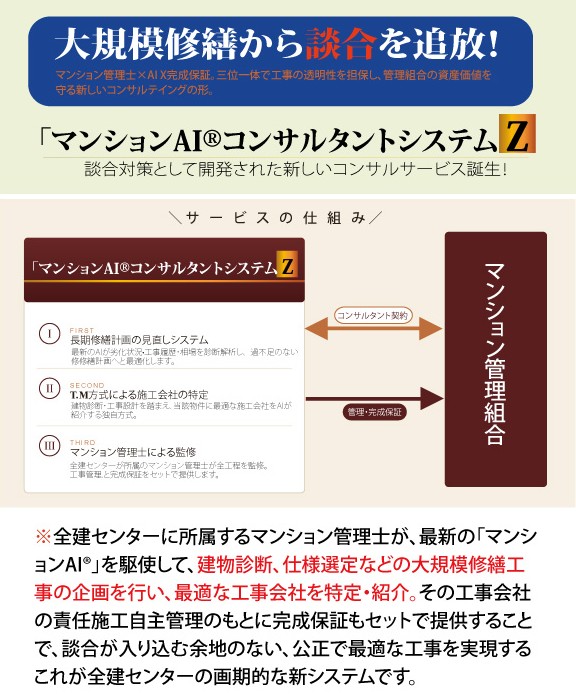
What you will learn in this seminar

In this 83rd online seminar, the National Building Survey and Diagnosis Center will provide a detailed explanation of "Mansion AI® Consultant System Z," a new service we have recently launched. We are proud to introduce this groundbreaking system, which leverages trending AI robot technology and incorporates supervision by certified condominium management consultants alongside a new type of building diagnostic report. By using this system to review long-term repair plans, you can also resolve issues related to bid-rigging. We encourage you to learn about this service and give it a try at your earliest convenience.
Zenken Bunko Collection Surpasses 66 Titles; Free Digital Versions Now Available.

 For over 17 years since its inception, the National Building Survey and Diagnosis Center (Zenken Center) has fostered connections with condominium management associations by regularly distributing the "Large-Scale Repair Work Newsletter." We have also held 82 seminars for management associations on a bimonthly basis. Furthermore, we have compiled the wealth of experience and information gathered through these activities into a series of publications known as the "Zenken Library," which now totals 66 volumes. Moving forward, we will continue to collect, edit, and disseminate information derived from our seminars, newsletter coverage, and the various consultations we handle. To mark the milestone of surpassing 65 volumes in the Zenken Library, we have made the e-book versions of these publications available to management associations and condominium residents free of charge. A list of the free e-books is available on our dedicated website; clicking on the image of a desired title prompts a request for a passcode—also provided on the site—which, once entered, opens the e-book version of that publication.
//z-center.net/zenkenbunko
Mr. Yoshino, Representative Director of Zenken Center, explained the motivation behind this release: "As these publications are highly valued by many condominium association board members as a vital source of information, and in keeping with the mission of our organization, we decided to make them widely available for free. We hope this will help resolve various issues facing the large-scale renovation industry." He also expressed his determination to continue publishing the *Zenken Bunko* series, aiming to reach a milestone of 100 volumes.
You can view or purchase (print editions) the *Zenken Bunko* series via the sites below:
1. By registering for the Zenken Library, you can view all volumes of the *Zenken Bunko* series as e-books.
//zenken-center.com/library
Zenken Library Subscription Registration
//credit.j-payment.co.jp/link/creditcard/input
2. Zenken Publishing Sales
//zenkenlibrary.shop-pro.jp
3.Amazon
4.TEBRA書店

Clicking the advertising banners below will open the respective company's website. (In no particular order)