Zenken Center Launches "Mansion AI®" Staff and AI Board Chairperson Services


Zenken Center has recently launched the "Mansion AI®" Specialist and "AI Board Chairperson" services.
This system enables condominium associations to seek ongoing advice and action from third parties certified by "Mansion AI" to facilitate better decision-making regarding large-scale repairs, plumbing and drainage system renovations, long-term repair plans, and more.
The AI Board Chairperson service offers the following capabilities:
| Relations with consulting firms | ① Validity of the inspection and diagnosis report ② Validity of the construction design details ③ Validity of the estimated construction cost ④ Validity of the construction company selection method ⑤ Evaluation of the construction company ⑥ Validity of the supervisor's inspection ⑨ Evaluation of after-sales inspections and handling of defects |
| Relations with the management company | ① Validity of the long-term repair plan ② Evaluation of the property management company |
| Regarding the construction company | ① Appropriateness of the construction contract terms ② Evaluation of the site representative's qualifications ③ Appropriateness of the construction company's inspections ④ Evaluation of after-sales inspections and handling of defects |
Case Studies
Case 1
A construction company was selected under the guidance of a consulting firm, but concerns regarding inflated margins or improper collusion remain. We would like a professional second opinion to verify whether the chosen contractor is truly the right choice.
Case 2
We requested an inspection and diagnosis from our property management company because they offered it for free, only to be told that a major renovation project was urgently needed to avert a disaster. We would like professional second-opinion advice on whether the work is truly necessary.
Case 3
We received a preliminary cost estimate from our property management company, but we suspect the price is higher than the market average. We would like a professional second-opinion assessment of the costs.
Case 4
We have consulted with contractors and consultants regarding renovation work for plumbing and drainage systems and would like professional second-opinion advice.
For more details, please visit:
//zenken-center.com/airt/
Consultation via email
info@zenken-center.com
Supervisory Actions Against Condominium Management Companies / Ministry of Land, Infrastructure, Transport and Tourism Three cases of embezzlement by former employees
 The supervisory actions taken by the Ministry of Land, Infrastructure, Transport and Tourism (MLIT) against condominium management companies between April and August 2026 are as follows. This information regarding administrative actions is a periodic compilation of measures taken against condominium management companies by the Minister of Land, Infrastructure, Transport and Tourism, the heads of Regional Development Bureaus, and others.
There were two cases involving the misappropriation of funds by former building managers (Kintetsu Housing Management Co., Ltd. and Daiwa LifeNext Co., Ltd.). The case involving Biken Techno Co., Ltd. concerned an incident in which a former section manager (responsible for client relations) misappropriated approximately 900 million yen from 14 management associations over a period of nine years. The former section manager was sentenced to five years and six months in prison, and Biken Techno was issued an order to suspend operations for 120 days—from May 19, 2026, to September 15, 2026—pursuant to Article 82 of the Act on Proper Condominium Management. Regarding the directive issued under Article 81 of the Act, the company was ordered to implement measures to prevent a recurrence of the violations, including: (1) promptly informing and thoroughly educating officers and employees; (2) formulating and continuously implementing internal training and education plans; (3) investigating and inspecting daily business operations and establishing internal operational management systems; and (4) formulating and continuously implementing appropriate measures to prevent recurrence.

 Here is a closer look at an embezzlement case involving Biken Techno Co., Ltd. (headquartered in Suita City, Osaka Prefecture)—an incident that led to a supervisory action by the Ministry of Land, Infrastructure, Transport and Tourism against the condominium management company.
【Overview of the Incident】
This case involved a former condominium management section manager (a man in his 60s) at the company who misused the bank passbooks and official seals of 14 client management associations. He fraudulently withdrew and embezzled funds, including repair reserve funds.
【Key Developments and Extent of Damage】
The long-standing unauthorized withdrawals came to light around November 2023, after the company launched an investigation upon becoming suspicious when they could no longer contact the employee in question.
The misconduct took place between 2015 and 2023, affecting 14 management associations with total losses amounting to approximately 910 million yen. This is considered one of the largest cases of embezzlement of condominium management association assets in history.
【Criminal Charges and Arrest】
In January 2025, the Osaka Prefectural Police arrested the former manager on suspicion of professional embezzlement, specifically for misappropriating approximately 47 million yen—including reserve funds—from a management association in Chuo Ward, Osaka City. Subsequent legal proceedings included additional indictments and charges related to fraud against subordinates.
In September 2025, the Osaka District Court sentenced the former manager to five years and six months in prison, describing his actions as "sophisticated and malicious" and noting that they had continued over a long period.
【Background of Discovery and Governance Issues】
1. Failure to Effectively Implement "Segregated Management" of Seals and Passbooks
The Act on Advancement of Proper Condominium Management mandates "segregated management"—requiring that bank passbooks and official seals be kept by different individuals to prevent fraud. However, the section in question failed to observe this rule, creating a situation where the former employee could freely embezzle funds and manipulate the accounts. 2. Long-term "black-box" operations and ineffective checks
A former section manager was solely responsible for specific accounting and management tasks, meaning that internal checks and systems of mutual oversight were not functioning.
3. Lack of clearly defined management procedures
Operations based on standard procedure manuals or management guidelines were neither documented nor strictly enforced within the company.
[Biken Techno’s measures to prevent recurrence]
Following the incident, an investigation committee involving external experts (lawyers and certified public accountants) was established, and the following organizational measures to prevent recurrence have been formulated and implemented:
1. Strengthening the structure of the Condominium Management Section
・Thoroughly documenting operational procedures in compliance with the Act on Proper Condominium Management.
・Enhancing the effectiveness of mutual oversight mechanisms (double-check systems) among staff members to prevent the concentration of authority in a single individual.
・Considering the transfer or separation of condominium management operations to a group company as a potential option.
2. Strengthening management and audit departments
・Accounting Department: Increasing management-level personnel to reinforce check-and-balance functions regarding the Condominium Management Section.
・Audit Office: Formulating specialized audit policies focused on legal compliance and operational characteristics, and enhancing internal audits by increasing staff.
[Post-incident response and impact]
Biken Techno acknowledged deficiencies in its management system and announced a policy to proceed with full repayment and compensation procedures, accepting liability for damages incurred by the affected condominium management associations.
In April 2026, the company received supervisory sanctions, including a business suspension order, from the Ministry of Land, Infrastructure, Transport and Tourism. The company is currently working to restore trust by fully compensating for the damages and revamping its governance structure as described above. Although the impact on the company's performance was temporarily severe, its core businesses—such as building maintenance and hotel operations—remained very robust; consequently, it is reported that the company avoided a fatal blow to its business performance or stock price that might have threatened its very survival.
Report on the 82nd Online Seminar for Management Associations: "Resolving Bid-Rigging Issues Starts with Reviewing the Long-Term Repair Plan"
 This is a summary and transcript of the 82nd Online Seminar for Management Associations, launched on August 30 by the National Building Survey and Diagnosis Center. In this session, we present a lecture by Ms. Kaori Segawa (Director/Avatar Representative) of the Center, titled "Solving Bid-Rigging Issues: Starting with a Review of the Long-Term Repair Plan."
Today’s theme is "Solving Bid-Rigging Issues: Starting with a Review of the Long-Term Repair Plan." We aim to provide a clear explanation covering a range of topics: the use of AI robots; a new long-term repair plan review service supervised by certified condominium management consultants; a new approach to building diagnostic reports; and the process of reviewing financial plans and building consensus among residents.

In recent years, concerns regarding transparency in commissioning and the reasonableness of costs in the construction industry—sparked by bid-rigging scandals involving property management firms, design and supervision offices, and construction companies—have been mounting, particularly concerning large-scale renovation projects for condominiums.
Against this backdrop, the National Building Survey and Diagnosis Center wishes to highlight a fundamental issue: the problem lies not only in the execution phase of the construction itself but also in the preceding stages—specifically, how long-term repair plans are formulated and revised, and how the condominium association structures its decision-making processes.
In today’s seminar, we aim to provide a clear explanation of several key topics: the use of AI robots; a new long-term repair plan revision service supervised by certified condominium management consultants; a new approach to building diagnostic reports; the revision of financial plans; and methods for building consensus among residents.
Today’s presentation covers six main themes:
1. Why is it necessary to revise long-term repair plans now?
2. What is the connection between bid-rigging issues in large-scale renovations and the revision of long-term repair plans?
3. Features of the new revision service launched by the National Building Survey and Diagnosis Center, which combines AI robot technology, supervision by condominium management consultants, and new building diagnostic reports.
4. Concrete examples of cost differences and financial planning based on model cases.
5. How to facilitate consensus-building among residents.
6. What steps condominium associations should take starting today.

1. Why is it necessary to review the long-term repair plan now?
First, I would like to reaffirm why this topic is important at this time.
The long-term repair plans you currently hold are based on the assumptions made at the time they were created. Given factors such as the progression of building deterioration, the usage patterns of various facilities, the composition of residents, and recent increases in prices and construction costs, a plan created in the past may not remain viable for the future.
In other words, a long-term repair plan is not something that is finished once created; it is a plan that requires continuous review to align with the building's current condition.
The service we have developed using AI technology highlights several reasons why such reviews are necessary: for instance, discrepancies inevitably arise between initial assumptions and reality as the building ages, and strategic decisions—such as sharing scaffolding or rescheduling work to an earlier date—can help minimize total costs.
A model case study indicates that if the current monthly repair reserve contribution of 12,000 yen remains unchanged, a shortfall of approximately 93 million yen is projected over the next 30 years.
This shortfall does not appear suddenly overnight; it quietly accumulates while reviews are postponed.
That is precisely why it is essential to take action before the problem surfaces.
2. Why is there a link between bid-rigging issues in large-scale repair projects and the revision of long-term repair plans?
When people hear the word "bid-rigging," they often picture the bidding or price-estimation stage.
In reality, however, the foundation for bid-rigging is often laid much earlier. It stems from a lack of transparency in the procurement process—specifically, proceeding without clearly defining what work is to be done, when, on what scale, and why.
When the management association lacks sufficient information to make informed decisions, struggles to interpret complex building assessment reports, cannot clearly see the necessity or priority of the work, or lacks adequate materials to explain the project to residents, they inevitably end up making decisions passively.
By revising the long-term repair plan, the management association gains the ability to explain—in their own words—why the work is necessary, why it is scheduled for that specific time, and whether there are any alternative options.
This is the fundamental link between revising the long-term repair plan and preventing bid-rigging.
3. Features of the review service launched by the National Building Survey and Diagnosis Center, which combines the use of AI robots, supervision by condominium management consultants, and a new type of building diagnostic report.
This service is characterized by its neutral stance and its combination of supervision by certified condominium management consultants, AI analysis, and a new type of building assessment report.
First is neutrality. By reviewing the plan as a third party—rather than from the perspective of a property management or construction company—we establish a foundation that makes it easier for the management association to explain the plan to residents.
Next, experienced, nationally certified condominium management consultants refine the plan into a feasible one, incorporating not only AI analysis but also practical considerations regarding management association operations, legal matters, and the process of building consensus among members.
Furthermore, the AI does not make the final decision; instead, it acts as a support tool that organizes historical data, the interrelationships between construction items, and potential scheduling adjustments, visualizing this information in a format that facilitates easy comparison.
Finally, there is the new building assessment report. By carefully grasping the building's current condition—taking its history into account—and conducting a review tailored to actual circumstances, we create a realistic long-term repair plan rather than one based merely on mechanical calculations. The process is structured into four stages: survey and diagnosis planning, plan review, financial planning adjustments, and consensus building.
4. Specific Cost Differences and Funding Plan Based on Model Cases
Let us now look at some specific figures.
The model case presented here is a 15-story, 50-unit reinforced concrete (RC) condominium in Tokyo that is 15 years old.
We will present the results of the service verification conducted on this property.
In this case, if the monthly repair reserve fund remains unchanged at 12,000 yen, a shortfall of approximately 93 million yen is projected over the next 30 years.
However, by optimizing the timing of work reviews and consolidating work items, the cumulative repair expenditure over 30 years can be reduced from the pre-review figure of approximately 419 million yen to approximately 398 million yen—indicating potential savings of about 21 million yen.
This reduction is not merely about cutting costs.
It is the result of restructuring the plan based on optimal premises—such as simultaneously executing work that shares scaffolding, or rescheduling tasks to occur earlier or later depending on the extent of deterioration—rather than simply cancelling the work itself.
In other words, repair costs vary significantly depending not only on *what* work is done but also on *how* the work is organized. This is where the true value of our long-term repair plan review service lies.
For instance, the cost of rooftop waterproofing might appear higher when viewed in isolation.
However, performing it alongside other work can lead to savings on scaffolding costs and improve overall process efficiency.
The same applies to sealant work. Taking early action can prevent secondary damage—such as water leaks or exterior wall deterioration—thereby curbing substantial repair costs in the future.
Furthermore, simply postponing major repair work is not always the best approach; depending on the building's condition, moving the schedule forward slightly may be more rational overall.
Ultimately, a review is not about reducing the amount of work, but rather about reconfiguring the entire plan to align with the building's actual condition. Given these factors, reviewing and raising the repair reserve fund has become one of the most challenging issues for many management associations.
However, the discussion often tends to become a binary choice between raising the fund or not; what truly matters is identifying a rationale for the increase that gains the residents' understanding while preventing future shortfalls.
The approach presented here outlines three main options. The first is maintaining the status quo. Under this plan, the monthly contribution remains at 12,000 yen, but a shortfall of approximately 93 million yen is projected over the next 30 years. The second option is a significant, immediate increase.
Raising the amount to 18,000 yen at an early stage makes it easier to avoid a funding deficit. The third option is a phased increase.
The current proposal suggests a two-step increase: raising the amount to 15,000 yen after six years and then to 18,000 yen after 16 years.
The advantage of this phased approach is that it allows for the planned accumulation of necessary funds while mitigating the sense of a sudden financial burden.
Additionally, comparative data shows the average repair reserve contribution for the 2018 fiscal year was 15,257 yen, indicating that a level of 18,000 yen is not excessively high.
Reviewing the reserve fund is not merely a matter of raising prices.
It is a question of how to prepare now to avoid the need for lump-sum levies or loans in the future.
5. Building Consensus Among Residents
The final hurdle encountered when reviewing a long-term repair plan is building consensus.
No matter how rational a plan may be, it cannot be implemented unless it is effectively communicated to and understood by the unit owners. Even if the Board of Directors is in agreement, the project cannot move forward without the understanding of the General Meeting.
The notice outlines a process that avoids an immediate vote at the General Meeting; instead, it begins by sharing the overall direction, followed by informational sessions and Q&A opportunities, before ultimately proceeding to a vote.
A plan becomes truly feasible only when residents understand it, recognize its necessity, and are convinced enough to take action.
6. What the management association should start doing today
To conclude, let me summarize the key points of today’s presentation. First, a long-term repair plan is not something that is finished once it is created.
It requires periodic review to adapt to the building's current condition and changes in the social environment. Second, simply maintaining the status quo is not a safe strategy.
In our model case, keeping the monthly contribution at 12,000 yen would result in a projected shortfall of approximately 93 million yen over 30 years.
Third, a review is not merely a price hike; it is a restructuring of the repair plan. By re-evaluating the timing, scope, and combination of construction work, it is possible to project a cost reduction of approximately 21 million yen over the 30-year period.
Fourth, AI is not meant to make decisions in place of humans; rather, it is a tool to assist human judgment.
Fifth, the ultimate key is building consensus.
A plan is only viable if the residents understand and accept it, allowing the project to move forward. Revising a long-term repair plan is about more than just adjusting numbers.
Amidst issues like bid-rigging scandals, it has become difficult to discern what truly matters. Many of you attending this seminar—members of management associations with a keen interest in these issues—likely struggle with knowing what or whom to trust.
Having objective data derived from AI supervised by a certified Condominium Management Consultant—a qualified professional—represents, in my view, the optimal approach at this time.
For those who wish to learn more about today’s topic or for management associations considering a review of their long-term repair plans, please refer to the information and service detail pages.
Thank you very much for your attention.
Reported cases of residential burglary in 2025 rose by 6.1% year-on-year to 18,007. Incidents of malicious burglary and robbery also occurred, regardless of whether residents were at home.
 Trends in Residential Burglary
According to the "Statistical Data on Penal Code Offenses" released by the National Police Agency in August of this year, the number of reported residential burglaries has fluctuated between the 16,000 and 18,000 ranges since 2021; in 2025, the figure stood at 18,007, marking an increase of approximately 6.2% from the previous year.
Regarding housing types, detached houses account for the overwhelming majority—over 70%—of cases; however, among multi-unit dwellings, a higher number of incidents is observed on lower floors.


Clearance rates have declined across the board; in 2025 (Reiwa 7), the rate stood at 46.3%, falling below the 50% mark.
In recent times, there have also been incidents of burglary and robbery involving malicious methods—such as smashing window glass to break into homes—regardless of whether the residents are present. To protect your own safety, that of your family, and your property, please take a moment to understand the current situation regarding intrusion-based crimes.
* "Other" refers to methods of intrusion-based theft other than "aki-su" (burglary of an unoccupied home), "shinobikomi" (stealthy entry while residents are asleep), and "i-aki" (theft while residents are at home but distracted), such as warehouse break-ins.


Q&A: Managing General Meetings of Condominium Associations
Following *Q&A: Amendments to the Act on Building Unit Ownership* and *Q&A: Amendments to the Standard Management Bylaws for Condominiums*, this is the third volume in the series, serving as a guide to conducting general meetings in compliance with the latest legal amendments.
In practice, knowledge of the law and standard bylaws alone is often insufficient for managing general meetings. Anticipating such situations, this book presents 124 court precedents related to meeting operations.
It covers changes resulting from recent legal amendments—such as procedures for convening meetings and resolution requirements—while also addressing practical issues like handling questions, motions, and disruptive attendees, as well as dealing with defects in resolutions. It serves as a valuable reference for general management associations.
"Q&A: Managing General Meetings for Condominium Associations
—A Practical Guide Incorporating the 2025 Legal Amendments—"
Published: August 29, 2026
Author: Susumu Watanabe
Format: A5 size, 174 pages
List Price: 3,300 yen (tax included)
Publisher: Taisei Shuppansha Co., Ltd.
ISBN: 978-4-8028-3656-2
(link)
//www.taisei-shuppan.co.jp/show/detail.html?code=3656
Unit Owner Sues Board Member Individually Over Water Leak Dispute / Court Dismisses Claim in Full, Finding No Personal Legal Liability for Board Member Amidst Personal Conflict

Tokyo District Court, June 25, 2024 – Case Claiming Damages
【Parties】
Plaintiffs: Company X (a unit owner) and X1 (Representative Director of Company X)
Defendants: Y1 (Board Chairperson at the time) and Y2 (Board Member)
【Judgment】
All claims by the plaintiffs are dismissed.
1 Overview of the Case
The case concerns a small condominium complex comprising ten units, completed in 1977. In June 2017, a large amount of water leaked from the ceiling of a ground-floor commercial unit (owned by Company X). The leak was caused by a backflow resulting from clogs in the bathroom drainage pipe of an upper-floor unit and the outdoor communal drainage pipe.
Consequently, Company X sought damages from Defendant Y1 (who served as the Board Chairperson of the management association) and Defendant Y2 (a board member) based on the following grounds:
【Plaintiffs' Arguments】
Neglect of cleaning obligations: They failed to clean the drainage pipes for approximately eight years, starting in 2009. The defendants breached their duty of care as prudent managers, thereby causing the plaintiffs to suffer damages.
Exclusion from general meeting convocations: From 2011 through November 2021, they intentionally withheld notices convening general meetings solely from Company X. Had Company X attended, the drainage pipe cleaning work would have been carried out regularly, and the incident in question could have been prevented.
【Defendants' Arguments】
Harassment: Company X had failed to pay any management fees for an extended period. Furthermore, when Representative Director X1 attended general meetings, he engaged in verbal altercations with other residents and harassed them, causing significant disruption to the management association's operations; consequently, the practice of sending general meeting notices to Company X was suspended. Bad faith regarding the plaintiff's claim: The management association’s failure to carry out drainpipe cleaning was due to a lack of funds, a situation caused in part by Company X’s failure to ever pay management fees or repair reserve fund contributions. For Company X—having failed to make these payments—to pursue this claim against individuals such as the board chairperson (Y1) constitutes a gross violation of good faith.
The central issue in the lawsuit was whether the modification of the handrails constituted a case of "exerting a special impact" as defined under the Act on Ownership, etc. of Buildings (Condominium Act). If such a "special impact" were recognized, the consent of the adversely affected unit owners would be required.
Although the court acknowledged that the installation of panels had indeed worsened sunlight exposure and the view compared to before, it dismissed Plaintiff X’s claim for the following reasons.
[Key Issue]
The primary point of contention in this case was whether officers of the management association bear direct liability toward individual unit owners. Based on the Condominium Act and the management bylaws, the court ruled that while the administrator (board chairperson) maintains a mandate relationship with the "body of unit owners (the management association)," it cannot be interpreted that they hold a separate mandate relationship with "individual unit owners."
In other words, the logic is that the duty of care of a prudent manager borne by the officers is owed strictly to the "organization known as the management association," not to Company X in its capacity as an individual member.
A ruling was also issued regarding liability based on tort (Article 709 of the Civil Code, etc.).
Decision on conducting cleaning: The timing of drainpipe cleaning is a matter left to the "discretion of the administrator (board chairperson)," taking into account the association's financial status and other priorities. Given the background of Company X’s long-term delinquency in paying management fees, the failure to carry out the cleaning was not deemed immediately unlawful. Failure to send notice of the general meeting: While the failure to provide notice itself was deemed a "breach of duty," the court held that there was no established "causal link" showing that—had Company X attended the meeting—the cleaning work would have been immediately carried out and the accident prevented.
[Conclusion]
The Tokyo District Court rejected all of Company X's claims regarding breach of obligation and tortious acts by Board Chairman Y and others, dismissing the suit in its entirety.
“Shashin de tadoru katte kimamana tabi nikki” (sono 4) 23 A Photo-Journal of My Carefree Travels (Part 4)

ビーチトレイン

東莱邑城址

Diamond Princess Cruise: July 28 – August 5 (Part 2)
On the 31st—the fourth day after departure—we docked at the port of Busan, South Korea, at 7:00 AM. Since I do not speak a word of Korean, I joined an organized Busan sightseeing tour costing 18,000 yen.
We began by strolling along the beach at Haeundae. Afterward, we boarded the seaside train at Haeundae Blue Line Park—which runs from Mipo through Cheongsapo to Songjeong—and took in the view from the Cheongsapo Daritdol Observatory, a bridge extending out over the sea.
After a lunch featuring Busan’s famous *Dongnae pajeon* (savory pancake) and *makgeolli* (rice wine), we visited the Dongnae Eupseong Fortress ruins. This site preserves many historical structures from the Joseon Dynasty and was a major battlefield during Toyotomi Hideyoshi’s invasions of Korea.
The fifth day was spent traveling from Busan to Aomori. On the sixth day, we disembarked at 10:00 AM and headed to "Wa Rasse" to prepare for the "Nebuta Festival," which began at 7:00 PM.
Shinmachi-dori, the street where the Nebuta parade takes place, was incredibly crowded, and every restaurant was fully booked. I struck up a conversation with an elderly woman who appeared to be a local resident, and I was surprised when she offered to let me use a chair set up along the street. It turned out she was a local landowner and the owner of a 12-story apartment building. She explained that she made the seats available to visitors coming to see the Nebuta; I was incredibly lucky to get a prime seat right at the front. (Photo 3: Chairs set up along the street)
People without chairs had been staking out spots on the roadside four or five hours in advance, so I was truly grateful for the offer. The woman was a prominent local figure who served as the president of the alumni association for Aomori Akenohoshi Junior and Senior High School. Thanks to her, I was able to thoroughly enjoy the magnificent Nebuta Festival.
After witnessing such a spectacular Nebuta Festival, I felt I would love to come back next year.
After watching the entire hour-and-a-half-long event, I returned to the cruise ship and had a late-night meal at Horizon Court, the restaurant on the 14th deck; my cabin was also located on the same deck.
The Nebuta Festival proved to be the highlight of this nine-day "Summer Vacation Cruise: A Tour of Japan and South Korea Amidst Festival Celebrations."

通り沿いに設置された椅子

ねぶた

ねぶた

ねぶた

ねぶた

ねぶた
Lessons Learned from the Great Earthquake: Considering the Unique Vulnerabilities of Condominiums and How to Prepare for Them
 Among the many lessons learned from the Kumamoto earthquakes, one theme that demands our particular attention is the damage sustained by condominium complexes.
Let us examine the vulnerabilities unique to condominiums and the key points for preparedness, as revealed by actual cases of damage.
First, consider the lessons regarding personal safety inside the home immediately after the quake strikes. Violent shaking can scatter shards of broken ceramics and glass across the floor, creating a hazardous environment where it is difficult to find a safe place to step. To ensure safe movement indoors, a vital first step for protecting one's life is to keep a pair of shoes in the bedroom at all times.
Damage to entrance doors can lead to even more serious situations.
Strong tremors can warp the door frame, preventing the door from opening; if forced open to allow for evacuation, the door may then become impossible to close.
There were numerous instances where residents had to make do by punching a hole in the wall and using a security chain or a combination lock to secure the door temporarily.
A major hurdle here lies in the circumstances unique to privately owned condominiums. Repairing doors—which are classified as common property—requires the homeowners' association to reach a consensus and secure the necessary funds.
If this process stalls, individual units may be left unable to lock their doors. Tragically, there are always thieves who exploit the chaos of a disaster to prey on others' misfortune; the frequent occurrence of burglaries highlights the existence of security challenges that individuals cannot overcome on their own.
Next, damage to infrastructure and essential utilities cannot be overlooked.
Even elevators equipped with state-of-the-art safety features—such as automatic earthquake control systems and devices to prevent movement while doors are open—saw frequent incidents of passengers becoming trapped. During the Kumamoto earthquakes, there were instances where rescue operations took as long as three to three-and-a-half hours.
To prepare for such emergencies, it is recommended that elevator cars be equipped with disaster-preparedness kits containing beverages, portable toilets, and lighting equipment.
Furthermore, damage to drainage systems in apartment complexes can be catastrophic.
To prevent severe water leakage into lower floors, the use of flush toilets is strictly prohibited. As it may take over a month to lift this restriction, the installation of communal portable toilets by the management association—combined with individual households stockpiling plenty of waste-disposal toilet bags—becomes a literal lifeline for daily life.
Another often-overlooked issue is waste management. If municipal garbage collection is suspended and residents continue to deposit trash at the collection point without established rules, a mountain of unsorted waste will quickly accumulate.
It can take a month for garbage collection to resume after a disaster, leading to foul odors and sanitation problems. Some management associations, unable to handle the disposal themselves, were ultimately forced to hire contractors, resulting in unexpected costs exceeding one million yen.
In an emergency, residents must exercise a high degree of self-discipline, sorting and storing their own waste within their units until the management association issues further instructions.
Disaster preparedness in apartment complexes cannot be achieved through individual efforts alone. From security measures to toilet usage and waste management, systems only function effectively when the management association—acting as a community—establishes rules and fosters a spirit of cooperation.
Rather than viewing the hard-learned lessons of the Kumamoto earthquakes as someone else's problem, why not take this opportunity to re-evaluate the disaster preparedness of your own apartment complex?
<Zenken Center / Large-Scale Repair Work Newspaper Editorial Committee: October 2, 2026>
"Mansion AI®" Utilization Tips 15 Let's Consult "Mansion AI®"!
 "Mansion AI®" Utilization Tips 15
Let's Consult "Mansion AI®"!
Zanken Center’s "Mansion AI®" is currently being used by board members and association members of numerous condominium complexes to ask questions and receive answers.
In this section, we present real-world examples of how management associations have utilized "Mansion AI®" over the past few months.
[Supervised by] Shigeyuki Sato, Lead Director, Zanken Center
Q
Ours is a 130-unit condominium complex. When the building was 15 years old, the management company spearheaded a complete replacement of the intercom system, costing 21 million yen. Now that the building has reached its 30th year, the management company has once again proposed a full replacement based on the repair plan; the current quote is 34 million yen.
We are weighing whether to proceed with the full replacement as scheduled in the repair plan or to investigate the extent of any malfunctions and forgo a total replacement if the number of defective units is low. Please let me know if you have any information on how other condominiums handle this situation.
 A
In a 130-unit condominium complex, the intercom system was replaced at a cost of 21 million yen when the building was 15 years old. Another 15 years have passed since then, bringing the building to the 30-year mark. The management company submitted a proposal for a complete system replacement—strictly following the long-term repair plan—that bore a price tag of 34 million yen.
In a Japanese society where wages and pensions remain stagnant while prices climb due to inflation, the prevailing sentiment is one of anxiety over seeing such a massive sum of money vanish from our pockets.
That 34-million-yen figure works out to approximately 260,000 yen per unit. Recalling that the cost was around 160,000 yen per unit 15 years ago, this represents a jump of roughly 1.6 times. Although we were already weary of hearing news reports about soaring material and labor costs, the reality of seeing our carefully accumulated repair reserve fund threatened in this way leaves us breathless.
It is only natural to wonder, "Since many units still have functioning systems, couldn't we simply inspect for defects and replace only the units that actually need it?"
The management company’s bold proposal is driven primarily by the issue of "limited parts availability."
Manufacturers typically stock repair parts for only 10 to 15 years after production ends. Even if a 30-year-old intercom system appears to be working perfectly, the moment a breakdown occurs, the reality is that replacement parts no longer exist—a fact used to press the case for a full replacement.
A single indoor unit failure could disrupt the connection to the main entrance's auto-lock system; in a worst-case scenario, the control panel for the common areas could reach the end of its lifespan, rendering the entire building's entry system inoperable. The argument is that the risks are too high, making an early replacement the prudent choice. That said, there is no need to simply accept the 34-million-yen quote at face value.
It is not uncommon for condominiums to cut out the middleman—the property management company—and obtain competing quotes directly from specialized intercom contractors, thereby reducing the budget to the low 20-million-yen range.
Costs can also be lowered by stripping away "excessive features"—such as smartphone integration or high-definition cameras—and opting for simpler specifications.
Furthermore, condominiums that successfully keep costs down do not view the situation as a simple binary choice of "replace or not"; instead, they navigate the process with flexibility.
Many condominiums wait until their intercoms actually break—or until there is a surge of complaints from residents about malfunctions—before replacing them; however, those that do not simply leave everything to the management company often begin considering a full replacement once the building is over 20 years old.
If that is the case, perhaps you could defer your current concerns for another six or seven years?
A repair plan is not an absolute rule that binds the future; it is merely a map to help you pause and assess the situation safely.
Before counting the number of malfunctions, start by asking the manufacturer about the "remaining lifespan for parts supply" for your current model. Then, verify the validity of the quote you received from a different perspective. It is worth broadening your options a little before letting the weight of that 34-million-yen figure overwhelm you.
Learning the Value of Behind-the-Scenes Work from the Folktale "Hiotoko"


There is a theory that the folktale of "Hi-otoko" (Fire Man) is the origin of the *Hyottoko* mask used in traditional *Kagura* performances.
The story goes that an old man once found a young man suffering from a stomachache in the mountains and brought him home. In gratitude, the young man worked for the couple; he used his strangely protruding, pointed mouth like a bamboo blowpipe to skillfully stoke the kitchen fire for cooking. The household prospered while he was there, but the old woman eventually grew to resent him and drove him away—whereupon the family’s fortunes immediately declined.
If we were to translate this story into a modern setting...
Imagine a thriving diner in the suburbs. Deep within the kitchen, there was a man who had spent seventeen years tending the fire. He was insecure about his appearance and so inarticulate that he couldn't even meet the customers' eyes.
Aside from the regulars, no one knew his name; even the new hires would laugh at him, calling him a "useless back-room guy."
Yet, he was the one who managed the fires—from the pre-opening preparations to the midday prep work. He knew the precise water temperature for the rice, the oil heat for the deep-fried dishes, and the subtle color changes of the charcoal glowing on the grill.
The owner's wife—the second-generation manager—disliked him. He was unsociable and showed no interest in learning customer service; she didn't even want him in the shop's promotional photos.
Eventually, she drove him out of the business.
A month after he left, the flavor of the food became inconsistent, and the restaurant's star ratings on review sites plummeted. In the end, the shop went out of business.
Where—and by whom—is the "fire" at your workplace being kept alive? The person tending that flame might be someone quiet and unassuming, yet they could actually be indispensable to the company. (Journalist Katsuhiko Inoue / Illustration: Tatsuchika Yoshida)
<Fun Column>
What you will learn in this seminar

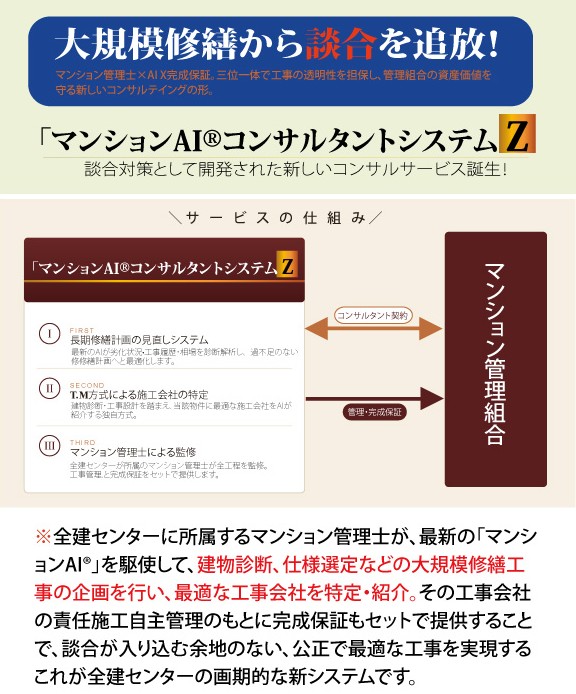
In this 83rd online seminar, the National Building Survey and Diagnosis Center will provide a detailed explanation of "Mansion AI® Consultant System Z," a new service we have recently launched. We are proud to introduce this groundbreaking system, which leverages trending AI robot technology and incorporates supervision by certified condominium management consultants alongside a new type of building diagnostic report. By using this system to review long-term repair plans, you can also resolve issues related to bid-rigging. We encourage you to learn about this service and give it a try at your earliest convenience.
Zenken Bunko Collection Surpasses 66 Titles; Free Digital Versions Now Available.

 For over 17 years since its inception, the National Building Survey and Diagnosis Center (Zenken Center) has fostered connections with condominium management associations by regularly distributing the "Large-Scale Repair Work Newsletter." We have also held 82 seminars for management associations on a bimonthly basis. Furthermore, we have compiled the wealth of experience and information gathered through these activities into a series of publications known as the "Zenken Library," which now totals 66 volumes. Moving forward, we will continue to collect, edit, and disseminate information derived from our seminars, newsletter coverage, and the various consultations we handle. To mark the milestone of surpassing 65 volumes in the Zenken Library, we have made the e-book versions of these publications available to management associations and condominium residents free of charge. A list of the free e-books is available on our dedicated website; clicking on the image of a desired title prompts a request for a passcode—also provided on the site—which, once entered, opens the e-book version of that publication.
//z-center.net/zenkenbunko
Mr. Yoshino, Representative Director of Zenken Center, explained the motivation behind this release: "As these publications are highly valued by many condominium association board members as a vital source of information, and in keeping with the mission of our organization, we decided to make them widely available for free. We hope this will help resolve various issues facing the large-scale renovation industry." He also expressed his determination to continue publishing the *Zenken Bunko* series, aiming to reach a milestone of 100 volumes.
You can view or purchase (print editions) the *Zenken Bunko* series via the sites below:
1. By registering for the Zenken Library, you can view all volumes of the *Zenken Bunko* series as e-books.
//zenken-center.com/library
Zenken Library Subscription Registration
//credit.j-payment.co.jp/link/creditcard/input
2. Zenken Publishing Sales
//zenkenlibrary.shop-pro.jp
3.Amazon
4.TEBRA Bookstore

下記の広告バナーをクリックすると、当該企業のHPが開きます。(順不同)